

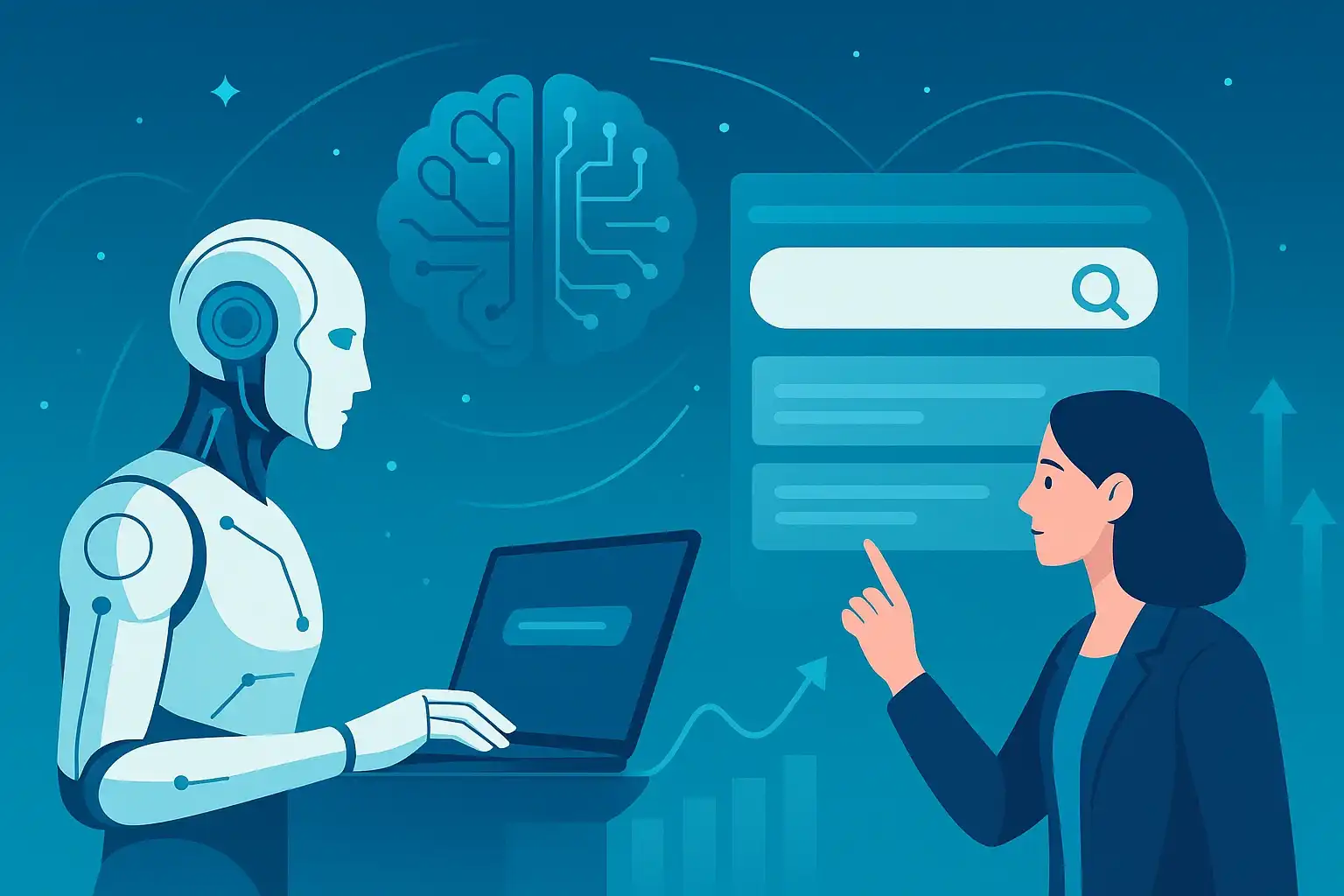
Artificial intelligence is reshaping digital marketing at a pace that was hard to predict, and nowhere is this more obvious than in search optimization. What Will Search Look Like in 2030?Here’s How AI-Driven Web3 Engines Are Reshaping the Future of SEOIn this article, The Future of AI in SEO: How Search Will Change by 2030, we investigate how search engines powered by AI will change what it means to rank on the web – and for your website’s performance and relationship with users – over the next 10 years.
Introducing the AI Revolution in Search
Search engines have transformed continually, but the shift from keyword-based algorithms to AI-optimized ranking procedures is nothing short of the biggest revolution in SEO history. The proliferation of machine learning, natural language processing and personalized search has left brands to recalibrate how they optimize content. It Will Be More Intuitive Chances are, within the next 10 years, search will feel more intuitive, conversational and predictive by 2030. Search engines won’t just be clubbing keywords – they’ll comprehend the intent, context, history and behavior of your audience so well that SEO will become seriously complicated. And those businesses that are already early adopters of AI-powered SEO will have overwhelming advantage as search continues to evolve.
AI Will Be More Intention Than AI Before
Among the biggest shifts happening by 2030 will be that search engines are getting so much better when it comes to understanding intent. Even today, SEO is moving away from those keywords, but in the future AI will understand deeper meaning, emotions and reasoning behind each query. Rather than serving coincidentally matching conversations, which were largely hit or miss opportunities, Google and subsequent search engines will recognize the user’s time-sensitivity, stage within the buying journey (and corresponding level of intent) and even content preference. This will make the SEO primarily about user goals AND much less about “classic” keyword-optimization. Sites that can do keyword theming will beat those who target keywords on a shallow level.
Personalized Search Will Redefine Rankings
By 2030, everyone will get hyper-personalized search results. Rankings you see will be tailored by search engines for your behavior in the past, location, browsing history, device settings and according to demographic trends and online behaviors. So two people searching the same phrase may get entirely different results. SEO approaches will become much more centered on audience segments, and content that accounts for different personas. Businesses will need to serve the right, adaptive content at different intent levels, preferences and regional needs. AI-powered personalization will force brands beyond the generic of optimization to individual experience.
AI Will Be the Real Answer Machine for Results in Serps
Google search results are increasingly returning answers via AI-driven summaries, snippets, and conversation responses. Zero-click search will be the new normal by 2030. Rather than being directed to links or pages on websites, users will frequently receive immediate answers via AI. This change will greatly affect traffics’ conduct. To stay relevant brands will also have to have content that can be easily extracted by search engines for summaries, but with enough depth and interest to keep users visiting the site. SEO will strike a new balance between catering to AI-enabling answers and providing insights deeper than mere surface-level information.
Search-based Predictions Will Lead to User Decisions
Predictive search is going to be much more advanced by 2030. Rather than waiting for a user to type or speak a query, AI will figure out what they’re after by considering everything it knows about the specific individual (patterns, previous searches, current activity and even tasks they’d stated off the internet). This gives businesses an understanding that they can no longer optimize reactively and must plan out strategies according to the perceived user requirements. Content planning will leave the past behind to anticipate questions ahead of time, predict trends and focus on behavior-driven insights. Brands that embrace predictive SEO will lead in user discovery.
AI Will Change the Way Quality Is Evaluated
Today, content quality is gauged by relevancy, readability, expertise, and engagement. AI will use deeper indicators by 2030. It will examine accuracy, emotional tone, factual coherence and quality, data sources, author expertise and long-term value. AI will also analyse content on the web in its entirety to assess originality and worth. Sites that scrape shallow or redundant information will fail to rank. Content will need to be more professional, credible and data-based. There will be more emphasis on expertise, and brands will have to shine a spotlight on real authors, authority signals and original points of view.
Visual/Multimedia Search Will Go Mainstream
The future of search will be dominated by AI-based visual recognition. Users will be able to search via images, videos, augmented reality and voice-operated visual explanations. This transformation places business needs to maximise multimedia assets alongside textual content. Image SEO, video transcriptions, AR-compatible content and AI-detectable visual metadata will be key. Sites are going to be left behind as we move into a world where images search is being the predominate discovery channel.
Even if Proof Flourishes, The AI-Based Tools Will Automate Much of the SEO Work
By 2030, many of the SEO activities people do by hand today will be done by an AI. Intelligent systems will perform the keyword research, the technical audit, content optimization suggestions, competitor analysis and performance tracking in real-time and with automation. That doesn’t mean agencies and SEO professionals will disappear out of existence; they’ll just move up the line to take more strategic decisions, use their creativity, understand and position a brand and really dig inside how consumer behavior works. Data will be the province of AI and direction will be the province of humans.
White Hat SEO Will Be More Critical Than Ever
Ethical SEO Will Assume a More and More Vital Role As AI Strengthens Transparency, truthfulness and confidence will determine ranking victories. Link schemes, spammy backlinks and black-hat strategies will be quickly identified and punished. Search engines will push brands to be more transparent and responsible about the data they deliver, challenging them to only provide what is precise and actually useful for users. It’s not only will ethical SEO be suggested, but further one it is necessary for ranking to hold.
So, final thoughts: The Future is AI-SEO-dominated.
That will be a completely different world of SEO by 2030 compared to today. AI will power all aspects of search, including intent understanding, personalized experiences, predicting needs, evaluating content quality and so on to providing instant answers. Companies that want to keep up need to be leveraging AI-driven strategies today. The future of search is for brands that adapt with technology, focusing on the value of the user, and knowing that ultimately SEO isn’t about rankings so much as it is about serving our human needs in a meaningful way.
