Here's a question worth sitting with for a second: the last time you needed a recommendation a dentist, a software tool, a good gift, a local service where did you actually ask?
If the honest answer is "I typed it into ChatGPT" or "I asked Perplexity" or "Gemini just told me" instead of scrolling ten blue links on Google, you're not alone, and you're not early to this shift anymore. You're standing in the middle of it. Millions of people now ask AI systems for recommendations the exact same way they used to ask a search bar except this time, there's no page of ten results to scroll through. There's just one answer. And your competitors are already fighting to be it.
This is the entire premise behind AIO AI Optimization and it might be the single most consequential shift in digital marketing since Google itself launched.
What Is AIO?
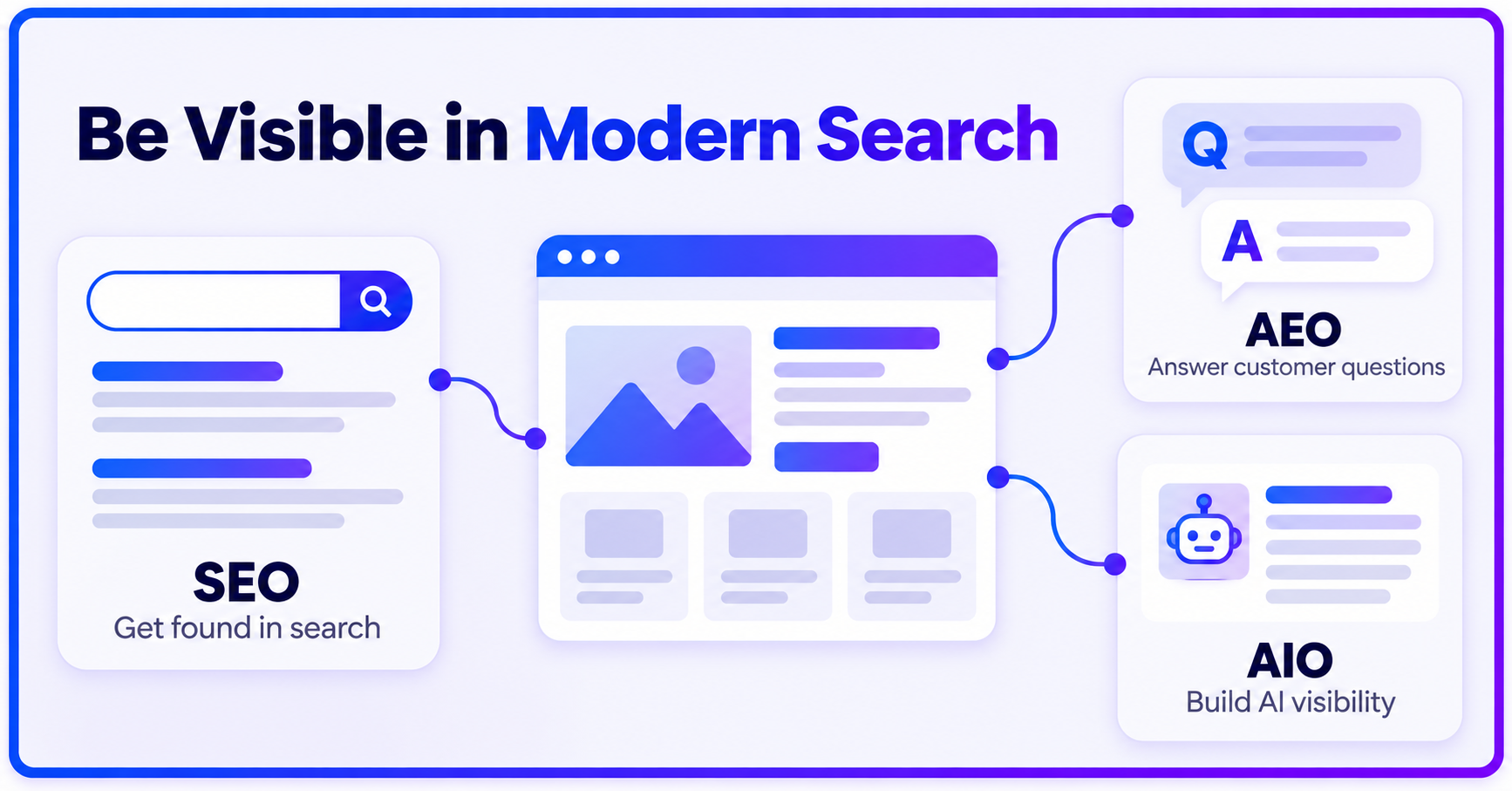
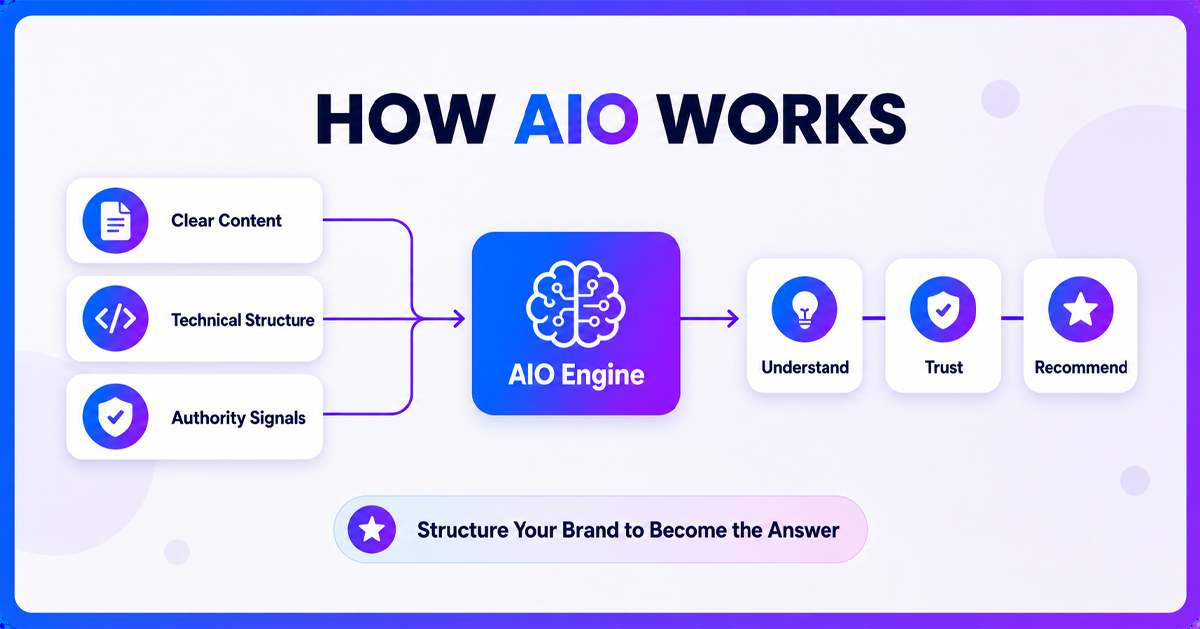
AIO, or AI Optimization, is the practice of structuring your brand's content, technical foundation, and authority signals so that AI platforms understand, trust, and recommend you. It's closely related to two other terms you may have heard AEO (Answer Engine Optimization) and GEO (Generative Engine Optimization) but AIO is the broader umbrella that ties them together. Where traditional SEO focuses on ranking links, AIO focuses on becoming the answer itself.
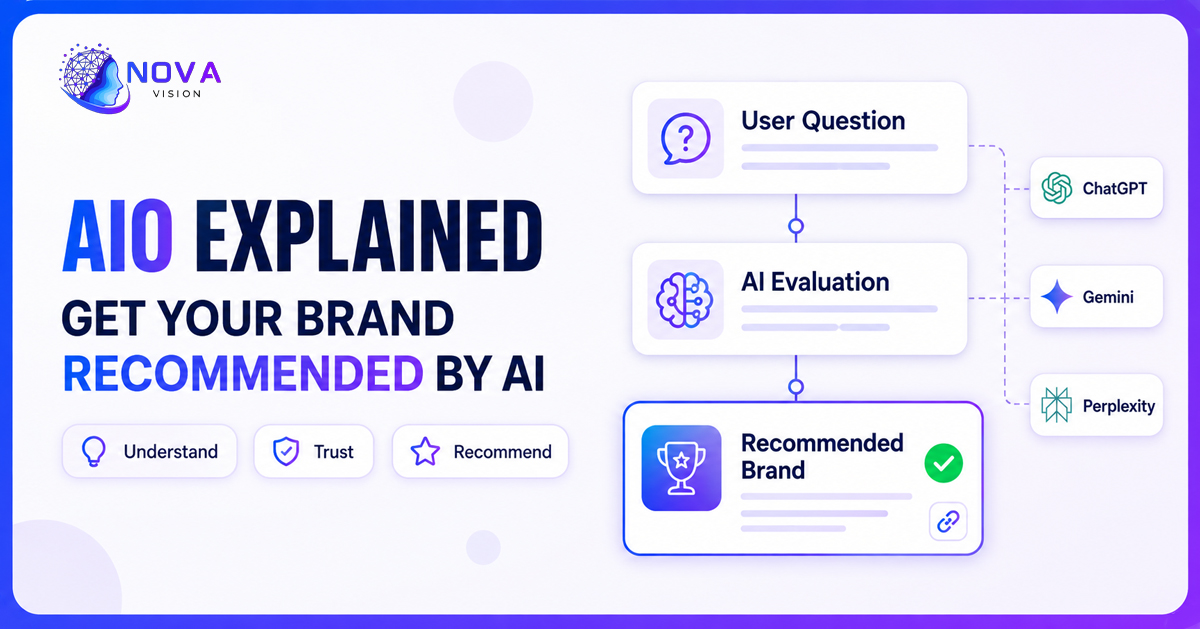
Search engines like Google are built to hand out links. AI platforms like ChatGPT, Gemini, and Perplexity are built to hand out direct answers. That single shift changes almost everything about how visibility works and it's why brands that dominate page one of Google can still be completely absent from an AI-generated recommendation.
So How Is This Different From SEO?
SEO's job is to get your website ranked on a results page a human then has to click through, read, and evaluate. It's a discipline built around pages titles, meta descriptions, backlinks, keyword density competing for a spot in a list.
AIO is a different discipline for a different moment. It's the practice of structuring your website, content, and brand signals so that generative AI systems ChatGPT, Google Gemini, Perplexity, Microsoft Copilot, Claude can actually understand, trust, and recommend your business when someone asks a question in your category. This is exactly the gap Nova Vision built its AIO service to close: there's no list, there's no page two, there's an answer generated in real time, and your brand either gets named in it or it doesn't exist in that conversation at all.
Think about what that means practically. When a user asks an AI assistant "what's the best CRM for a small team" or "which digital marketing agency should I use in Noida," the AI isn't ranking ten blue links for the user to evaluate themselves. It's synthesizing an answer and naming names usually two or three. Being SEO-ranked #1 on Google guarantees you nothing in that conversation. Being AIO-optimized is what gets you named.
Why This Is Happening Faster Than Most Businesses Realize
A few converging forces are making this urgent rather than theoretical:
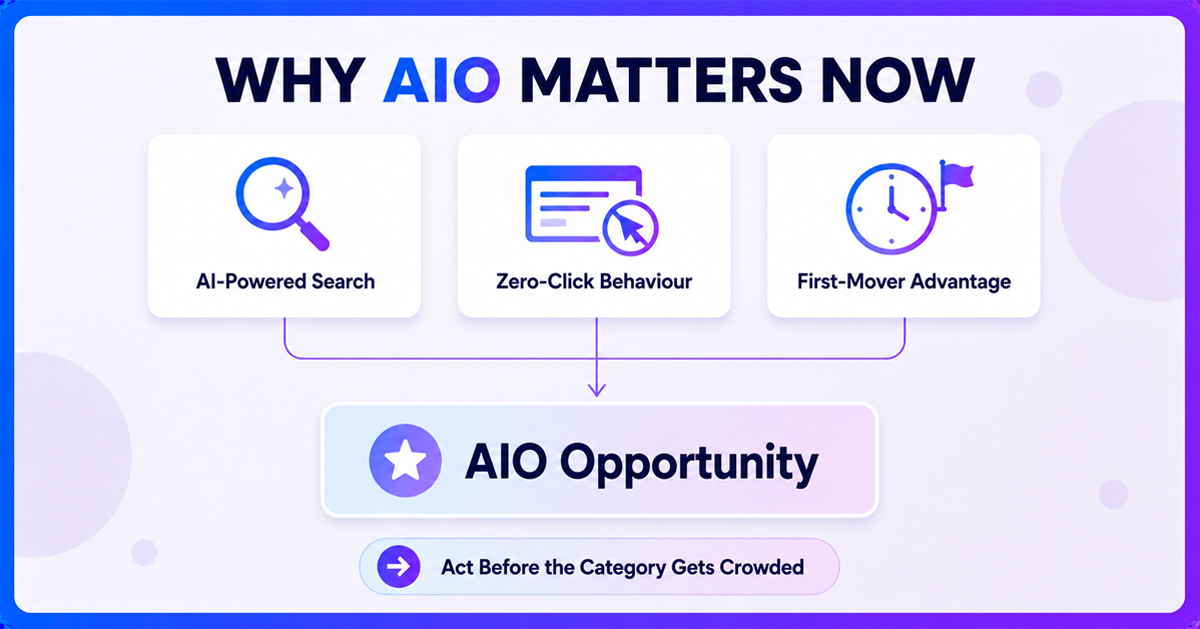
AI-powered search is now the default starting point for millions of queries. Google's own AI Overviews now answer a huge share of searches directly on the results page meaning a growing number of users never click through to a website at all. They read the AI's summary and move on. If your brand isn't the source that summary is built from, you've lost the customer before you ever had the chance to make your case.
Zero-click behavior is compounding. Every year, a larger share of searches end without a single click to any website. The AI answered the question. The user got what they needed. Traditional SEO built entirely around earning that click is optimizing for a moment that's disappearing.
Trust signals for AI are different from trust signals for Google. Google's ranking algorithm and an AI model's "who do I recommend" logic don't weigh the same signals the same way. Structured data, clear factual claims, consistent brand mentions across the web, and content that directly and unambiguously answers a question all matter more to an AI system deciding who to cite than traditional backlink profiles do.
First-mover advantage is real, and it's shrinking fast. Right now, most businesses in most categories have done nothing to optimize for AI recommendation. That means the businesses moving on this today are effectively claiming category territory before their competitors even know the game has changed. That window won't stay open for long as more brands catch on, the advantage of being early evaporates.
What Actually Makes an AI System Recommend a Brand
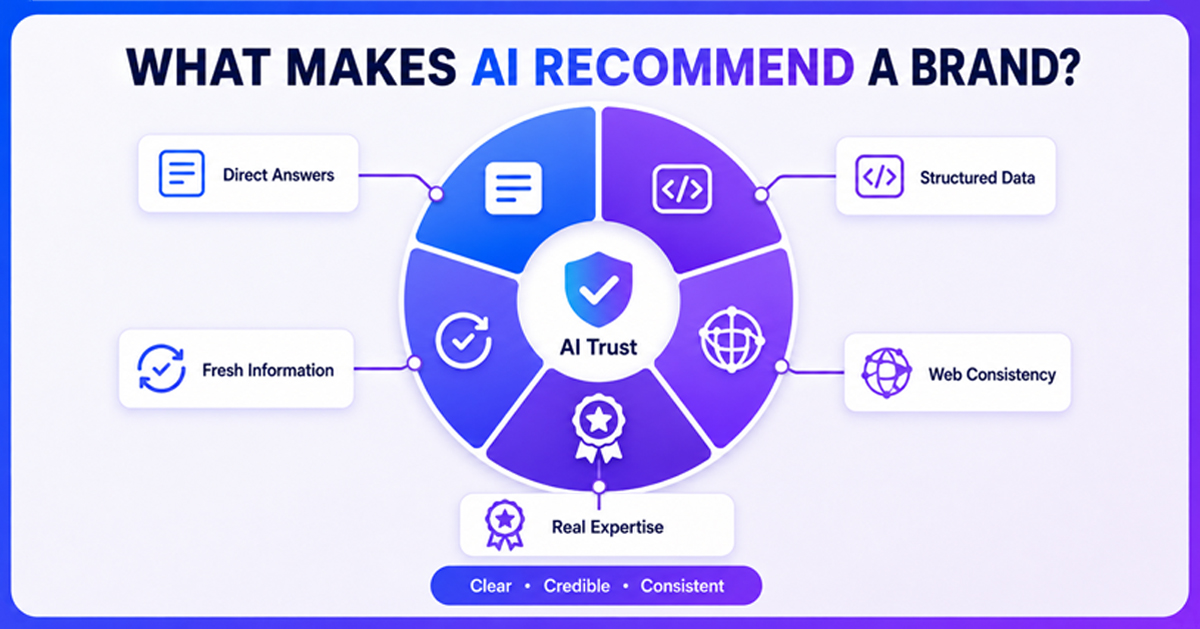
This isn't guesswork or a black box AI models are trained to trust certain patterns of information over others. A few of the biggest levers:
-
Unambiguous, direct answers. AI systems favor content that states a clear answer plainly "the best X for Y is..." over content that buries the point in five paragraphs of preamble. This is a genuine departure from a lot of traditional SEO content, which is often written to maximize time-on-page rather than to answer fast.
-
Structured, machine-readable data. Schema markup, well-organized headings, and clean factual formatting help an AI model parse exactly what your business does, for whom, and how it compares the same way it would parse a Wikipedia infobox.
-
Consistency across the web, not just on-site. AI models draw on far more than your own website review platforms, directories, forums, news mentions, and third-party comparisons all shape whether a model trusts and recognizes your brand as an authority in its category.
-
Genuine expertise signals. Content that demonstrates real depth specific numbers, named methodology, credentialed authorship tends to be trusted and cited more than generic, templated marketing copy that could describe any business in the category.
-
Freshness and accuracy. AI models are increasingly cautious about citing outdated or inconsistent information. A business with contradictory details across its web presence (old pricing, outdated service lists, inconsistent NAP data) is a harder brand for a model to confidently recommend.
What Happens to Brands That Skip This
It's tempting to treat AIO as optional a "we'll get to it eventually" item behind SEO, ads, and social. That's a more expensive mistake than it looks like today, for one simple reason: AI recommendation habits are being formed right now, and they're sticky.
When a model consistently recommends a competitor in your category, it's not just missing you once it's building a pattern of association that reinforces itself with every future query. The businesses being cited today by AI systems are quietly compounding an advantage that gets harder to unseat the longer it goes unaddressed. Meanwhile, brands with zero AI presence aren't just invisible in a new channel they're invisible in a channel that's actively replacing the old one for a growing share of buying decisions.
So What Does an AIO Strategy Actually Involve?
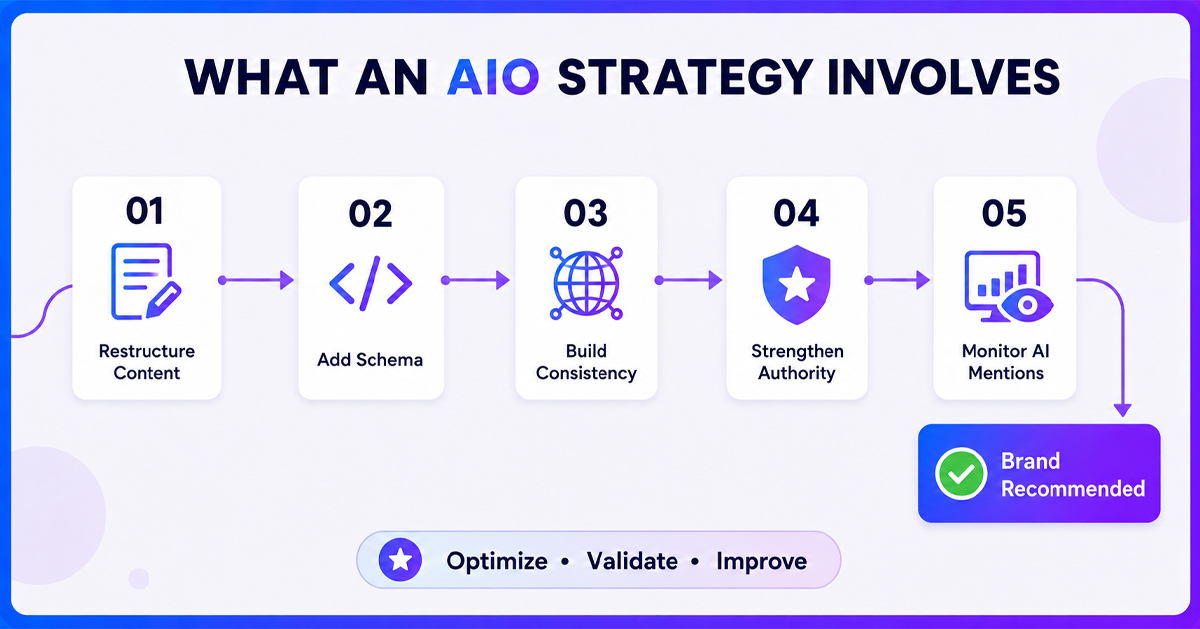
A serious AI Optimization approach isn't a single tactic it's a coordinated effort across several fronts:
-
Content restructured for direct-answer clarity rewriting key pages so the core answer to a likely question appears fast, plainly, and unambiguously near the top.
-
Structured data and schema implementation making sure AI crawlers can parse exactly what your business is, does, and serves without ambiguity.
-
Consistent brand presence across third-party sources reviews, directories, comparison sites, and industry mentions that reinforce the same facts about your business everywhere they appear.
-
Authority-building content genuinely expert, specific, well-sourced material that gives an AI model a reason to trust your brand over a generic competitor.
-
Ongoing monitoring of how AI systems actually describe your brand because unlike a Google ranking, you can't just check a rank tracker; you have to actually ask the models what they say about you, and adjust.
AIO ≠ SEO Here's the Real Difference
No. And the distinction matters more than it sounds.
SEO's job is to get your website ranked on a results page a human then has to click through, read, and evaluate. It's a discipline built around pages titles, meta descriptions, backlinks, keyword density competing for a spot in a list.
AIO is a different discipline for a different moment. It's the practice of structuring your website, content, and brand signals so that generative AI systems ChatGPT, Google Gemini, Perplexity, Microsoft Copilot, Claude can actually understand, trust, and recommend your business when someone asks a question in your category. This is exactly the gap Nova Vision built its AIO service to close: there's no list, there's no page two, there's an answer generated in real time, and your brand either gets named in it or it doesn't exist in that conversation at all.
Think about what that means practically. When a user asks an AI assistant "what's the best CRM for a small team" or "which digital marketing agency should I use in Noida," the AI isn't ranking ten blue links for the user to evaluate themselves. It's synthesizing an answer and naming names usually two or three. Being SEO-ranked #1 on Google guarantees you nothing in that conversation. Being AIO-optimized is what gets you named.
Put side by side, the two disciplines are optimizing for almost opposite outcomes:
|
SEO |
AIO |
|
|
Goal |
Earn a click to your page |
Earn a mention in the AI's answer |
|
Competing against |
Other ranked pages |
Other brands the model could name |
|
Success measured by |
Rankings, click-through rate, traffic |
Citation frequency, share of AI voice |
|
Content style |
Long, keyword-optimized, built to hold attention |
Direct, structured, built to be quoted |
|
Trust signals |
Backlinks, domain authority |
Consistency, structured data, third-party corroboration |
|
User sees |
A list of options to compare themselves |
One synthesized answer, already decided |
The two aren't in competition with each other, and dropping SEO in favor of AIO would be a mistake a strong website with solid technical SEO is still the foundation an AI model pulls from when it's deciding what to trust. But treating AIO as "SEO with extra steps" misses the point entirely. SEO wins you a spot on a page a human still has to evaluate. AIO wins you the evaluation itself, done on your behalf by the AI, before the user has to lift a finger. That's not a bigger version of the same game it's a different game, with different rules, being played for a prize SEO was never built to win.
The Businesses Winning at This Aren't Necessarily the Biggest Ones
Here's the encouraging part: because AIO is still so new, category dominance isn't locked in by brand size or ad budget the way it often is in traditional search. A focused, well-executed AI Optimization strategy can put a mid-sized or local business in the recommendation set alongside or ahead of much larger competitors who simply haven't adapted yet. The playing field, for now, is unusually open.
That won't last. It never does.
The Bottom Line
The way people find businesses is changing faster than most marketing strategies have caught up to. Search is no longer just a list of links it's increasingly a single, AI-generated answer, and there's no page two for that answer. Being the brand an AI system trusts enough to name isn't a future consideration anymore. It's a present one, and the businesses treating it that way right now are the ones building an advantage their competitors will spend years trying to catch up to.