If you have spent any budget on digital ads in the last few years, you have almost certainly benefited from programmatic advertising without necessarily knowing the term. Every time an ad appears next to the article you are reading, chosen and placed within milliseconds based on who you are and what you have browsed recently, that is automated, auction-based ad buying at work. It has quietly become the dominant way display, video, and even audio ads are bought and sold online, and yet a surprising number of business owners still associate digital advertising purely with running a Google Search campaign or boosting a Facebook post.
At Nova Vision, this is one of the most common gaps we see when auditing a client's existing marketing stack: businesses spending steadily on search and social, while a much larger, automated opportunity to reach audiences across the open web goes completely untapped. This approach is not a niche enterprise tool anymore; it is increasingly accessible to mid-sized businesses too, but it is also genuinely not the right fit for everyone, and understanding that distinction matters more than chasing the latest ad-tech trend.
This guide breaks down what this automated ad-buying model actually is, how it works behind the scenes, what it costs, and how to honestly assess whether it belongs in your marketing budget. Where relevant, we will also point to how Nova Vision approaches this decision with clients, since the honest answer for many small businesses is that this channel is not yet the right next step, and that nuance rarely makes it into vendor pitches.
What Is This Automated Ad-Buying Model, Really?
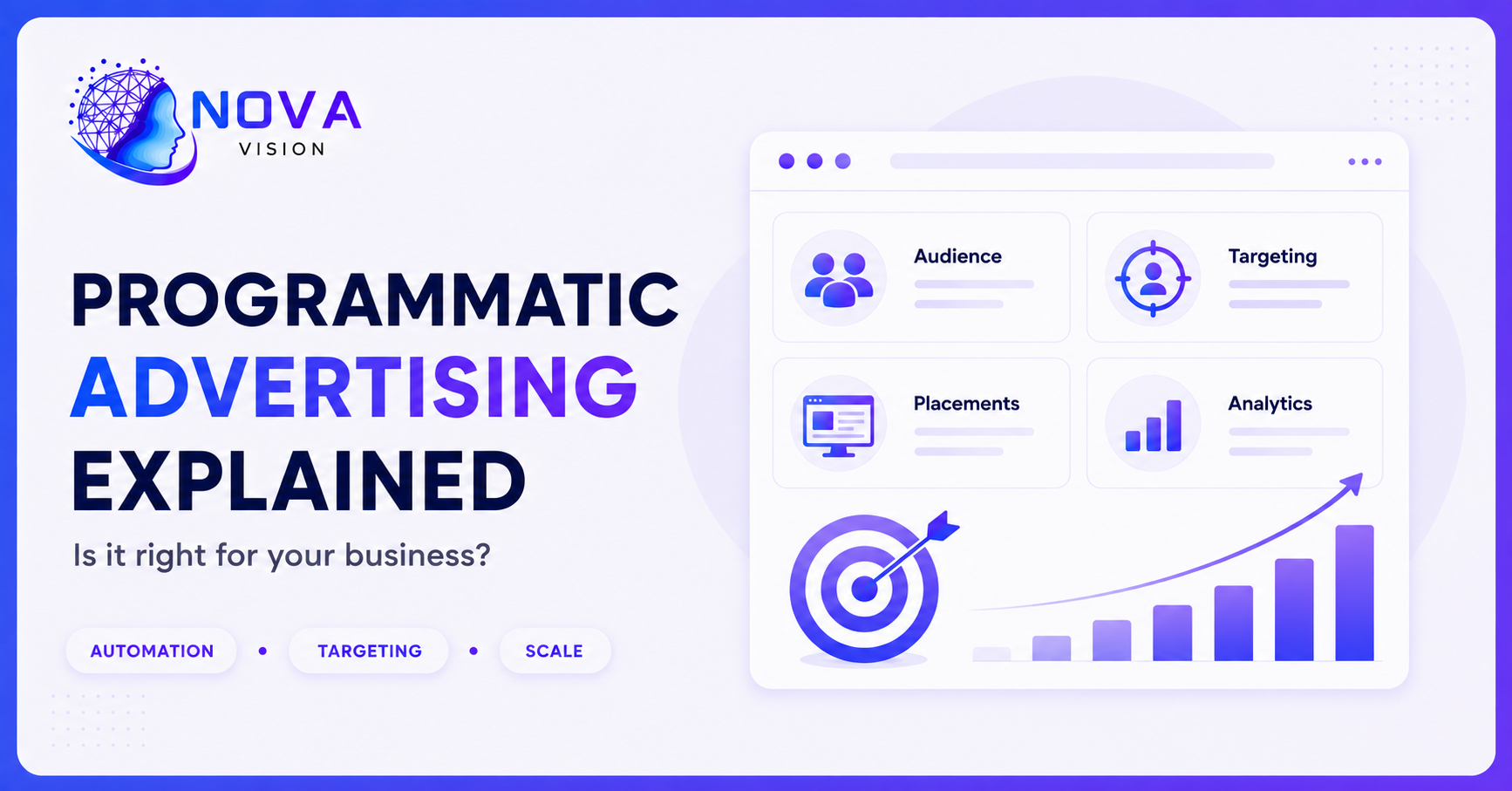
Programmatic advertising is the automated buying and selling of digital ad inventory using software rather than manual, human-negotiated insertion orders. Instead of a media buyer calling up a publisher to book a banner placement for a fixed price and duration, this system uses real-time auctions to match advertisers with available ad space the instant a webpage loads, based on data about the specific visitor viewing that page.
The entire process, from a user landing on a webpage to an ad appearing in front of them, typically happens in under 100 milliseconds. This speed is what makes the format so powerful: it allows advertisers to bid for exactly the right impression, for exactly the right audience, at exactly the right moment, rather than buying broad blocks of inventory and hoping the right people see it.
How the Ecosystem Actually Works
Understanding this space requires understanding a handful of core components that work together in every transaction:
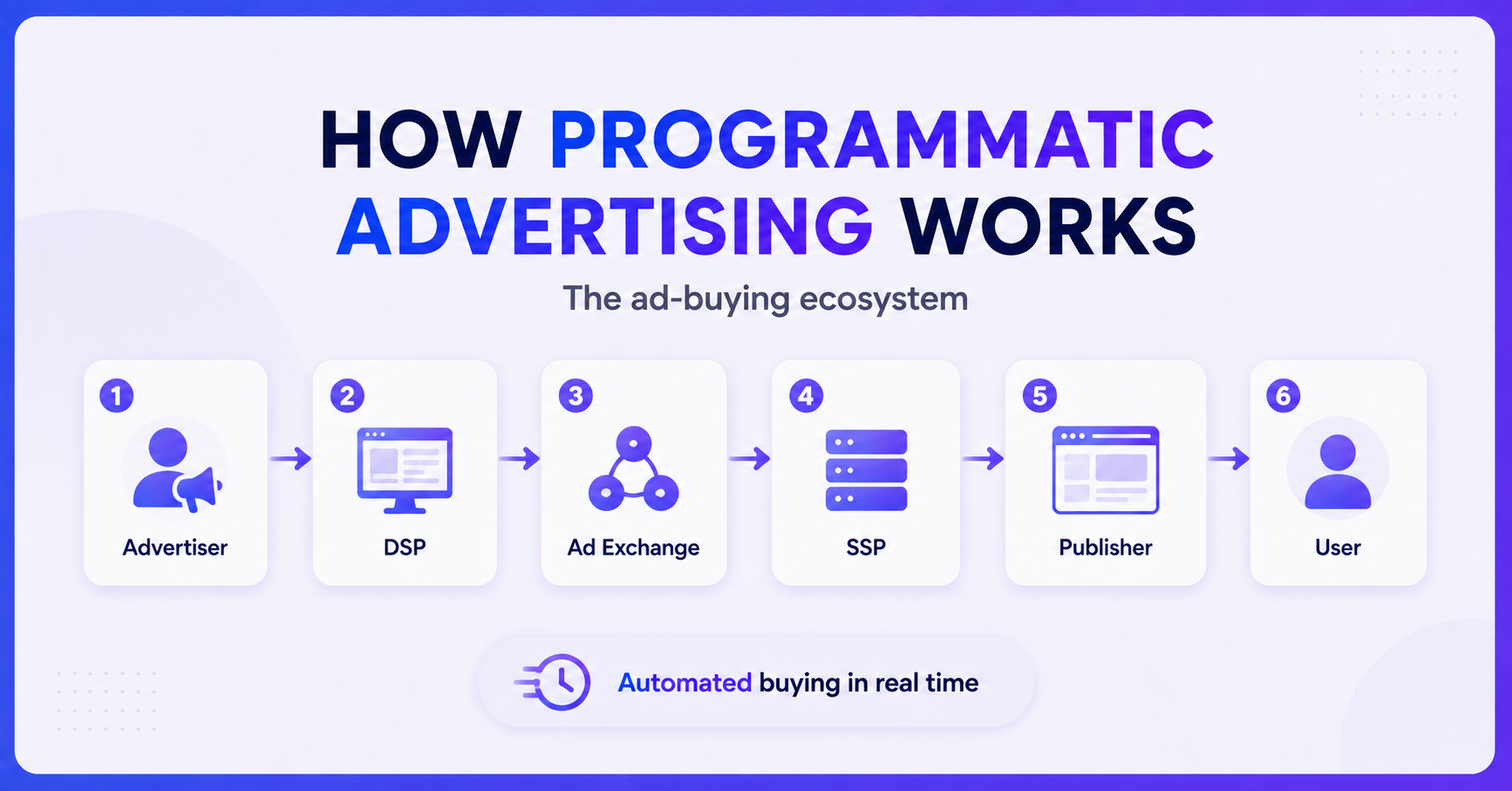
• Demand-Side Platform (DSP): the software advertisers use to set targeting parameters, budgets, and bids, and to actually purchase ad impressions across multiple ad exchanges at once.
• Supply-Side Platform (SSP): the software publishers use to make their available ad inventory visible to advertisers and to run the auction for each impression.
• Ad Exchange: the digital marketplace connecting DSPs and SSPs, where the real-time auction for each individual impression actually takes place.
• Data Management Platform (DMP): the system that aggregates and organises audience data, such as browsing behaviour, demographics, and interests, used to inform targeting decisions.
• Real-Time Bidding (RTB): the auction mechanism itself, where advertisers bid against each other for a single ad impression as a webpage loads, with the highest qualifying bid winning the placement instantly.
Put together, this ecosystem means an advertiser can set a target audience once, say, people who have visited a competitor's pricing page in the last 14 days, and have that targeting logic automatically buy impressions across thousands of different websites and apps, rather than negotiating placements site by site.
How It Compares to Search and Social Advertising
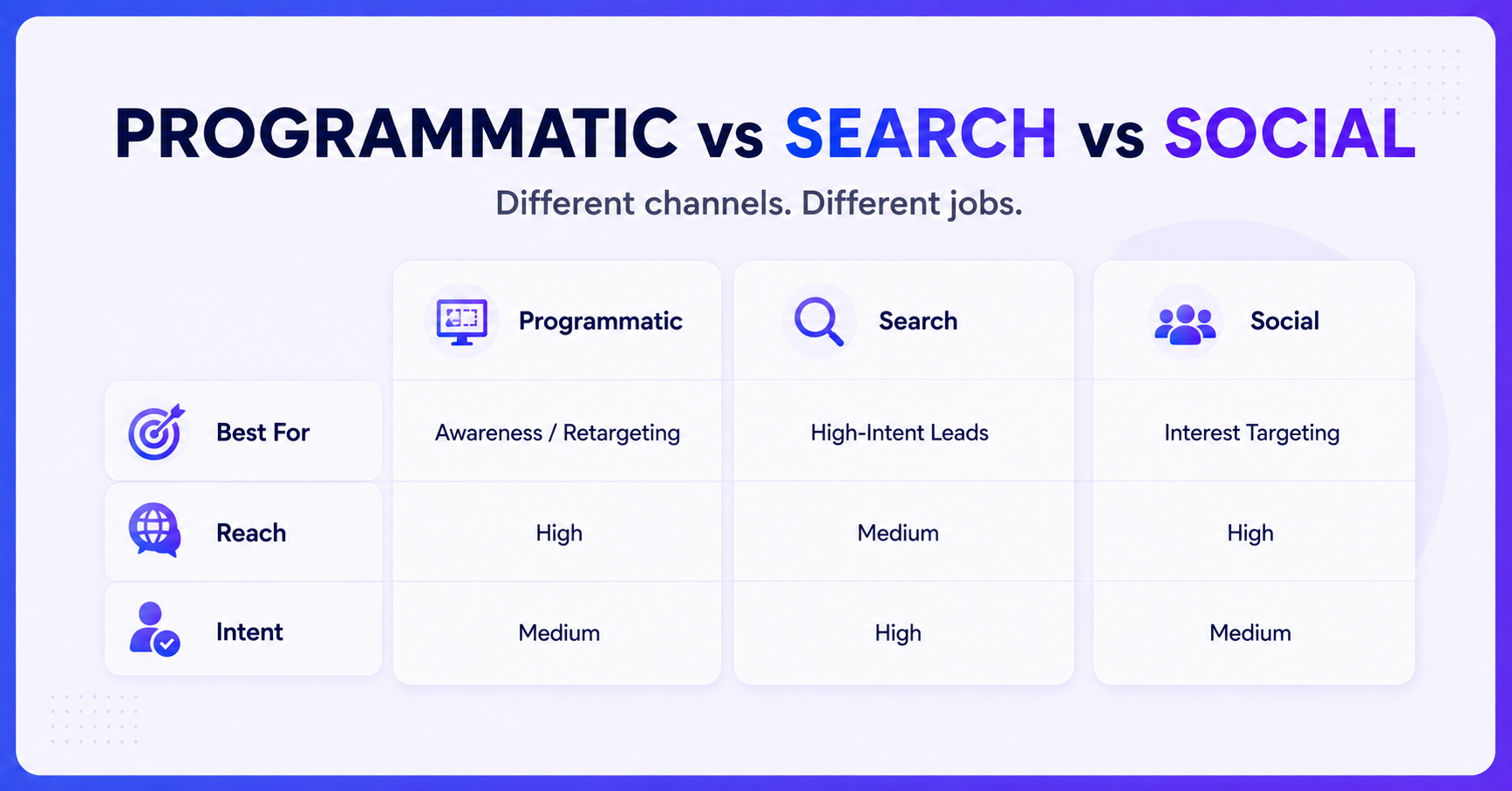
It helps to draw a clear line between this automated buying model and the search or social campaigns most small businesses are already familiar with. Search advertising, such as Google Ads, targets user intent at the moment someone actively searches for something. Social advertising targets users based on platform-specific profile and behavioural data within a single walled garden like Meta or LinkedIn. This model, by contrast, extends reach across the broader open web and app ecosystem, buying inventory across potentially millions of individual websites and apps rather than a single platform.
This makes the approach particularly effective for brand awareness, retargeting, and reaching audiences at scale across a fragmented media landscape, but it generally does not capture the same high-intent, bottom-of-funnel behaviour that search advertising does. Most mature marketing strategies use it as a complement to search and social, not a replacement for either. A useful way to think about it: search captures demand that already exists, while this channel helps create and sustain awareness that eventually turns into that demand.
The Real Benefits of This Approach
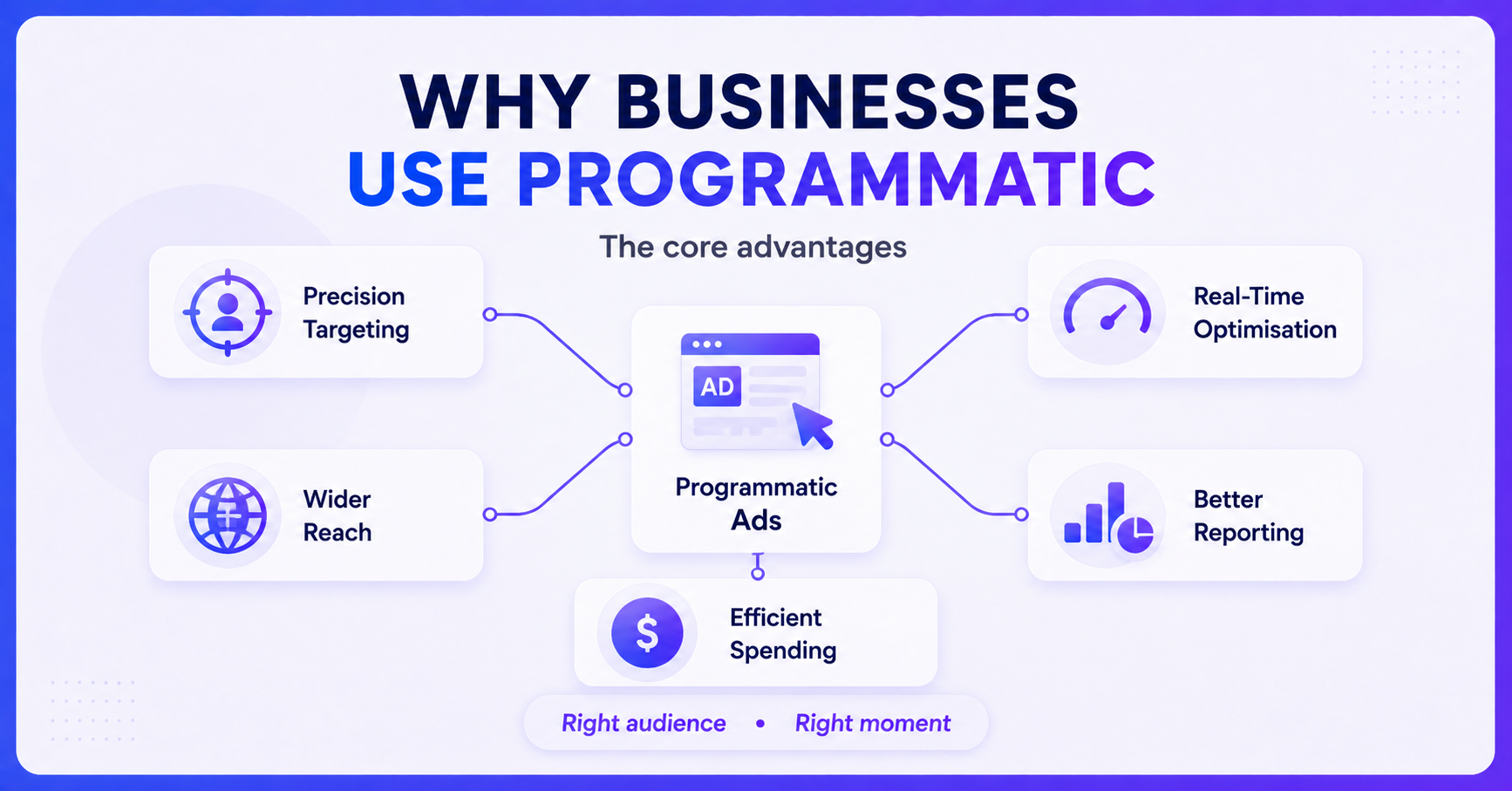
• Precision targeting: audiences can be defined by behaviour, demographics, location, device, past site visits, and dozens of other signals, often layered together for very specific segments.
• Massive scale and reach: a single campaign can run across thousands of publisher sites and apps simultaneously, something impossible to negotiate manually.
• Real-time optimisation: budgets can be automatically shifted toward better-performing placements, audiences, and creative variations while a campaign is still live.
• Transparent, granular reporting: most platforms provide impression-level data on where ads ran, who saw them, and how they performed, offering far more visibility than a traditional media buy.
• Efficient use of budget: because you are only paying for impressions that match your specific targeting criteria, wasted spend on irrelevant audiences can be significantly reduced compared to broad, un-targeted buys.
The Honest Downsides and Risks
This channel is not without genuine drawbacks, and any agency that presents it as a universal solution is doing clients a disservice. Ad fraud remains a real concern in parts of this ecosystem, with bot traffic and fraudulent inventory able to consume budget without ever reaching a real person, which is why working with reputable, verified platforms and exchanges matters considerably. Brand safety is another consideration: because ads can appear across such a vast range of sites, there is a risk of placement next to content that does not align with a brand's values unless proper exclusion lists and safety controls are configured correctly.
There is also a real learning curve and management overhead. Effective campaigns of this kind require ongoing optimisation, careful audience and placement management, and a reasonable minimum budget to gather enough data for the platform's algorithms to actually learn and improve performance. For a business with a very limited monthly ad budget, that data-gathering phase alone can consume a disproportionate share of total spend before returns start to materialise.
What This Typically Costs
Budget expectations vary widely depending on industry, audience size, and objective, but a few general patterns hold across most campaigns of this kind. Costs are usually structured on a cost-per-thousand-impressions basis, meaning the total spend scales directly with how much reach you are targeting. Highly specific, competitive audience segments, such as decision-makers in a narrow B2B category, tend to cost more per impression than broad consumer retargeting pools, simply because more advertisers are bidding for the same limited inventory.
As a rough starting point, campaigns that run with too small a budget to gather meaningful data rarely perform well, since the underlying algorithms need a certain volume of impressions and conversions before they can optimise intelligently. Businesses considering this route should budget not just for media spend itself, but also for a realistic testing and learning period, typically several weeks, before drawing firm conclusions about performance.
Formats Worth Knowing
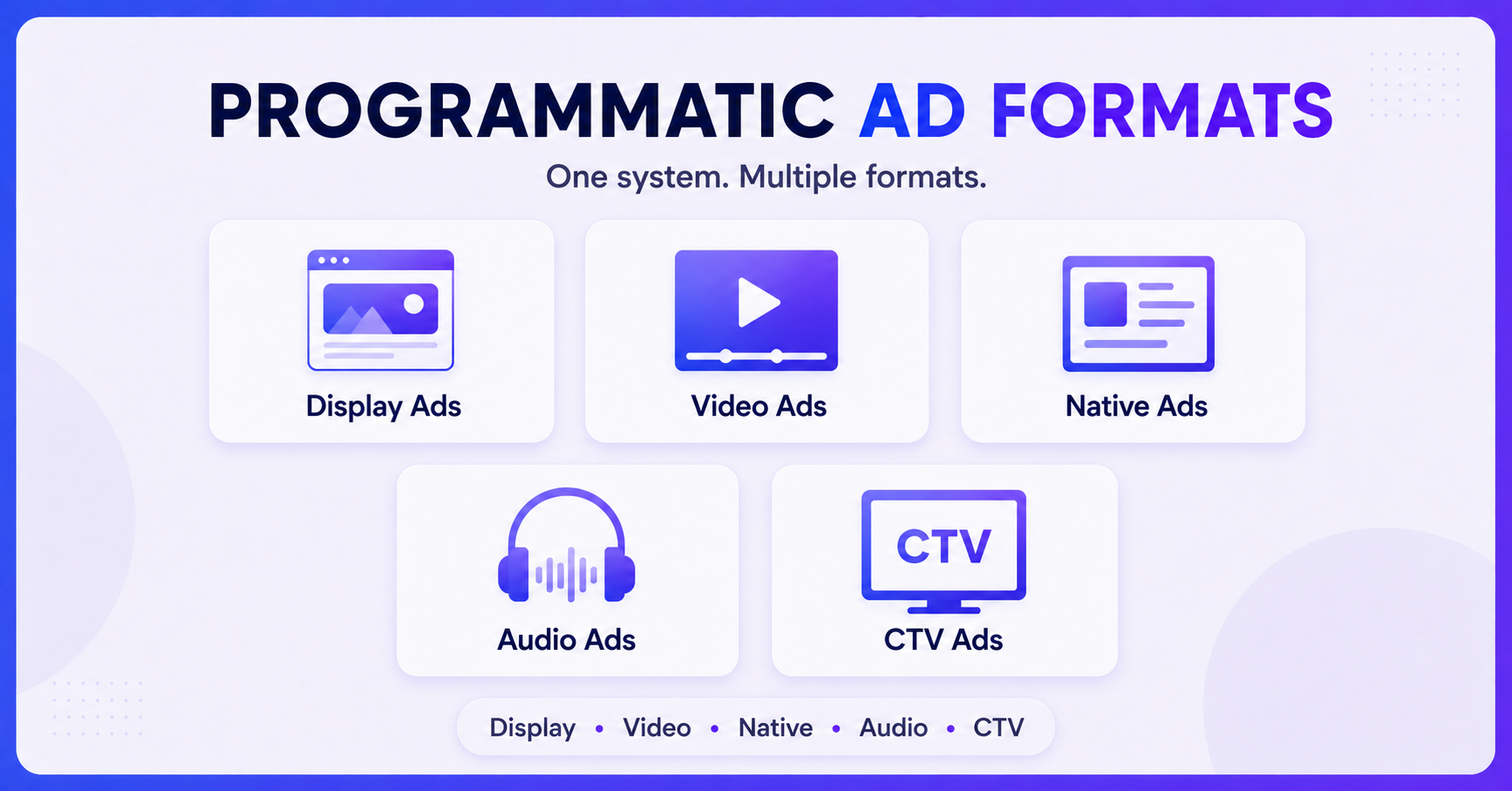
This kind of automated buying is not limited to standard banner ads. Understanding the range of formats available helps clarify how flexible this channel actually is for different marketing goals.
• Display advertising: the most common format, covering standard banner and rich-media ads served across websites and apps.
• Video advertising: pre-roll, mid-roll, and out-stream video ads bought through automated auctions across publisher video content and connected TV inventory.
• Native advertising: ads styled to match the look and feel of the surrounding content, often used for sponsored articles or in-feed placements.
• Audio advertising: this buying model has extended into streaming audio and podcast inventory, targeting listeners based on similar behavioural and contextual data.
• Connected TV (CTV): a fast-growing category allowing advertisers to buy targeted ad spots across streaming platforms, combining the reach of traditional TV with the targeting precision of digital.
Each format suits different objectives. Display and native tend to work well for retargeting and awareness at scale, while video and CTV are increasingly used for brand storytelling that used to be reserved for traditional television budgets alone.
Which Industries Tend to See the Strongest Results
Not every business category gets equal value from this channel, and it is worth being specific about where it tends to perform best. E-commerce brands with an existing base of site visitors often see strong results from retargeting campaigns that bring shoppers back to abandoned carts or recently viewed products. Businesses with longer sales cycles, such as B2B software or professional services, tend to benefit more from sustained brand-awareness campaigns that keep the business visible throughout a buyer's research phase, rather than expecting immediate conversions.
Local, service-based businesses with a narrow geographic radius and limited monthly budget are typically the weakest fit, since the audience pool is too small for the auction-based system to gather enough data efficiently, and a well-run local search or social campaign will usually stretch the same budget further. Recognising which category your business falls into before committing spend is one of the simplest ways to avoid a disappointing first campaign.
Is This the Right Move for Your Business?
This is the question that matters most, and the honest answer depends heavily on a few specific factors rather than company size alone.
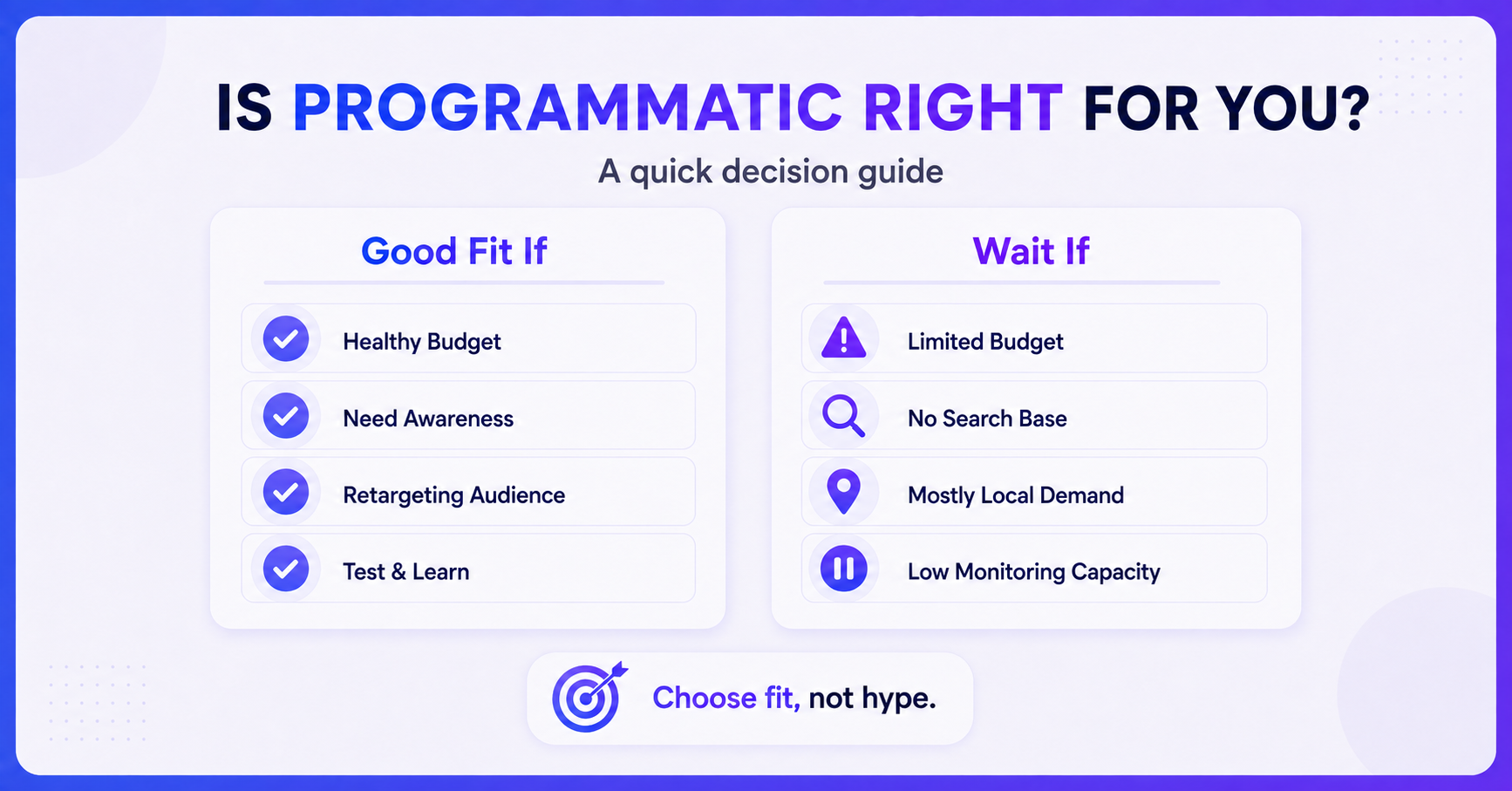
You are likely a good fit if:
• You already have a reasonably consistent monthly ad budget and are looking to extend reach beyond search and social.
• Brand awareness and top-of-funnel visibility matter to your business, not just direct-response conversions.
• You have an existing base of website visitors worth retargeting across the wider web.
• You are comfortable with a data-driven, iterative approach that improves over the first few weeks rather than delivering instant results.
You may want to wait if:
• Your monthly ad budget is very limited, since campaigns of this kind generally need sufficient scale to optimise effectively.
• You have not yet built a foundation of search or social campaigns that are performing predictably.
• Your business relies almost entirely on local, high-intent search demand, where search advertising alone may already cover most of your addressable opportunity.
• You do not have the internal or agency capacity to monitor placements and brand safety settings on an ongoing basis.
How Nova Vision Approaches This Decision with Clients
When a client asks Nova Vision whether they should be running campaigns of this kind, the answer is never a reflexive yes. The team starts by reviewing what is already in place, current search and social performance, existing site traffic volume, and overall budget, before recommending this channel as a next step. In several cases, Nova Vision has advised clients to strengthen their search and retargeting fundamentals first, since this approach tends to perform best as a layer added on top of a working foundation rather than a starting point on its own.
For clients who are ready, Nova Vision typically starts with a focused pilot, a specific audience segment and a defined budget, rather than a broad, unfocused rollout, so that performance data can genuinely inform whether and how to scale the approach further. This measured entry point tends to produce more reliable results than jumping straight into a large spend without a clear read on how the specific audience and creative combination is actually performing.
Measuring Success: What Metrics Actually Matter
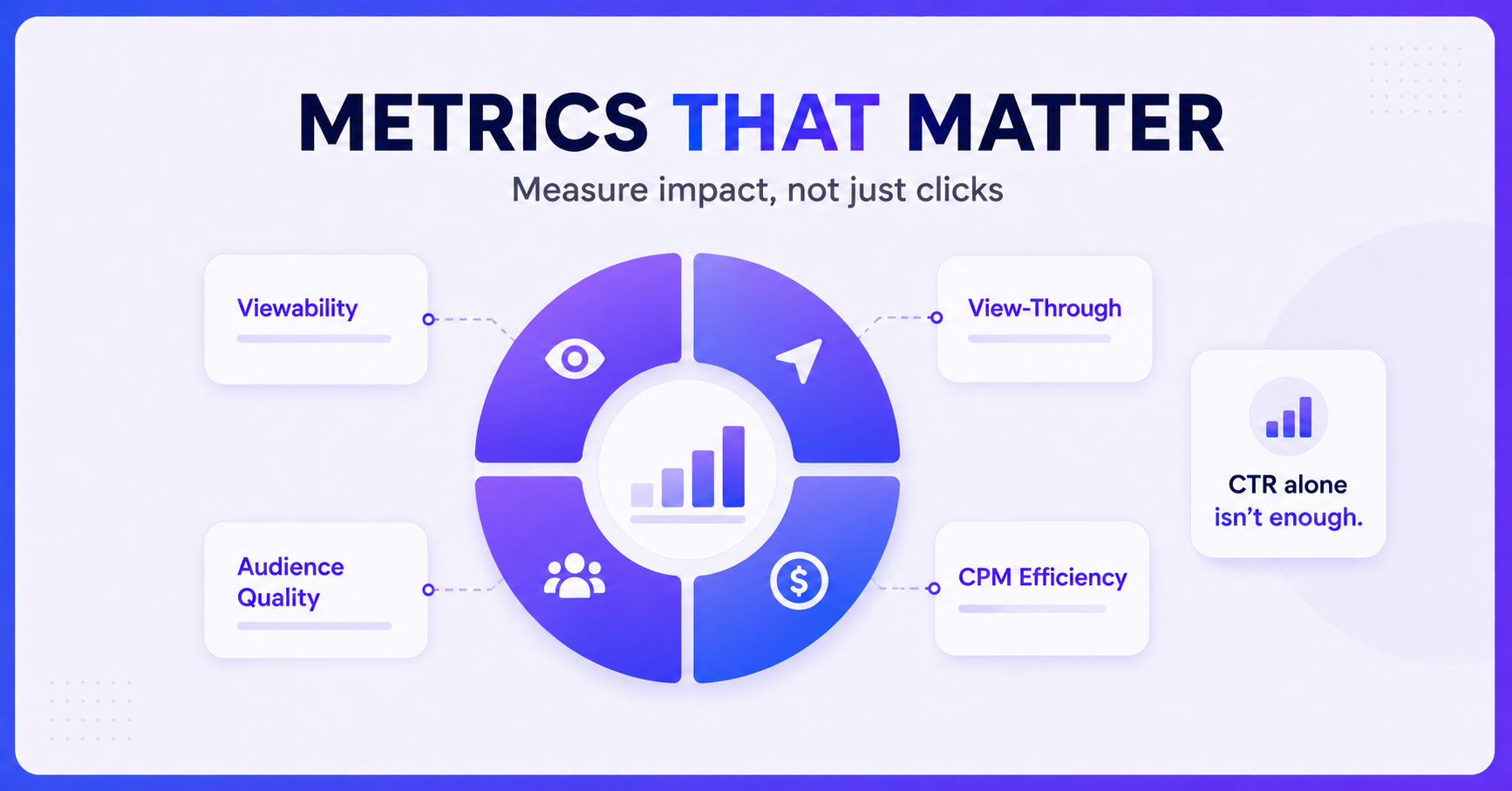
One of the more common mistakes businesses make when testing this channel for the first time is measuring it against the wrong benchmarks. Click-through rate, a metric borrowed from search advertising, is often a poor indicator of performance here, since much of the value lies in view-based brand impact and assisted conversions rather than direct clicks. More meaningful metrics typically include viewability rate, which measures whether an ad was actually visible on screen, view-through conversions, which track actions taken after someone saw but did not click an ad, and cost per thousand impressions relative to the quality of the audience reached.
Setting realistic benchmarks before a campaign launches, and reviewing performance against those specific goals rather than generic industry averages, makes it far easier to judge honestly whether a campaign of this kind is actually working for your business rather than simply generating activity.
Getting Started: What to Ask Before You Commit
If you are considering this route for your business, a few questions are worth asking any agency or platform before committing budget. Ask exactly which DSPs and ad exchanges will be used, and whether they have established fraud-prevention and brand-safety measures in place. Ask how audience segments will be defined and how first-party data, such as your own website visitors, will be used within the campaign. Ask what minimum budget is genuinely needed to gather enough data for meaningful optimisation, rather than accepting a generic recommendation. And ask for reporting transparency: you should be able to see where your ads actually ran, not just aggregate performance numbers.
Where This Is Heading
A few shifts are worth watching if you are weighing this decision for the medium term rather than just the next quarter. The gradual phase-out of third-party cookies across major browsers is pushing the industry toward contextual targeting and first-party data strategies, meaning the audiences you can reach effectively will increasingly depend on the quality of your own website and customer data rather than third-party tracking alone. Connected TV inventory continues to grow quickly as more viewing shifts to streaming platforms, opening up premium video placements that were previously reserved for large national advertisers. And artificial intelligence is increasingly being used within these platforms to improve creative optimisation and audience prediction, which should gradually lower the budget threshold needed to see meaningful results over time.
Conclusion
Programmatic advertising has earned its place as one of the more powerful tools in digital marketing, offering precision, scale, and efficiency that traditional media buying simply cannot match. But power and fit are two different things, and the businesses that get the most value from this approach are the ones that adopt it deliberately, with a clear budget, a defined objective, and realistic expectations about the optimisation period required to see strong returns.
Whether this channel belongs in your marketing mix right now depends on where your business currently stands, not on how compelling the pitch sounds. If you are unsure where that line falls for your specific situation, that is exactly the kind of assessment worth getting a second opinion on before committing budget, and it is the starting point Nova Vision uses with every client evaluating this option for the first time.