Most online store owners eventually hit the same wall: traffic is coming in, but sales aren't growing at the same pace. You run ads, get clicks, and watch a frustrating share of visitors add products to cart and vanish. The problem usually isn't any single channel it's that SEO, paid ads, email, and checkout experience are all being run in isolation, when they need to work as one connected system.
That's the core idea behind working with a dedicated e-commerce marketing agency: instead of stitching together freelancers for ads, someone else for SEO, and a plugin for abandoned carts, every stage of your funnel is built and optimized together, with one team accountable for how it all performs. This guide breaks down what a true full-funnel e-commerce marketing engine looks like, why ROAS and AOV matter more than raw traffic, and how a structured process turns a leaking funnel into a compounding growth machine.
Why E-commerce Marketing Is Different From Everything Else
E-commerce isn't like brand marketing or lead-gen marketing, where a form fill counts as a win. In e-commerce, you live and die by three numbers: Return on Ad Spend (ROAS), Average Order Value (AOV), and Customer Lifetime Value (LTV). A campaign that drives thousands of visitors but converts poorly, or attracts one-time buyers who never return, isn't actually growing your business it's just burning ad spend.
This is why e-commerce marketing has to be engineered end-to-end. Abandoned cart recovery, product feed optimization, and retargeting can't be bolted on as an afterthought once traffic is already flowing in they need to be built into the funnel from day one, alongside real-time visibility into daily sales, ad spend, and ROAS so you always know exactly where your money is going.
What a Complete E-commerce Marketing Engine Actually Covers
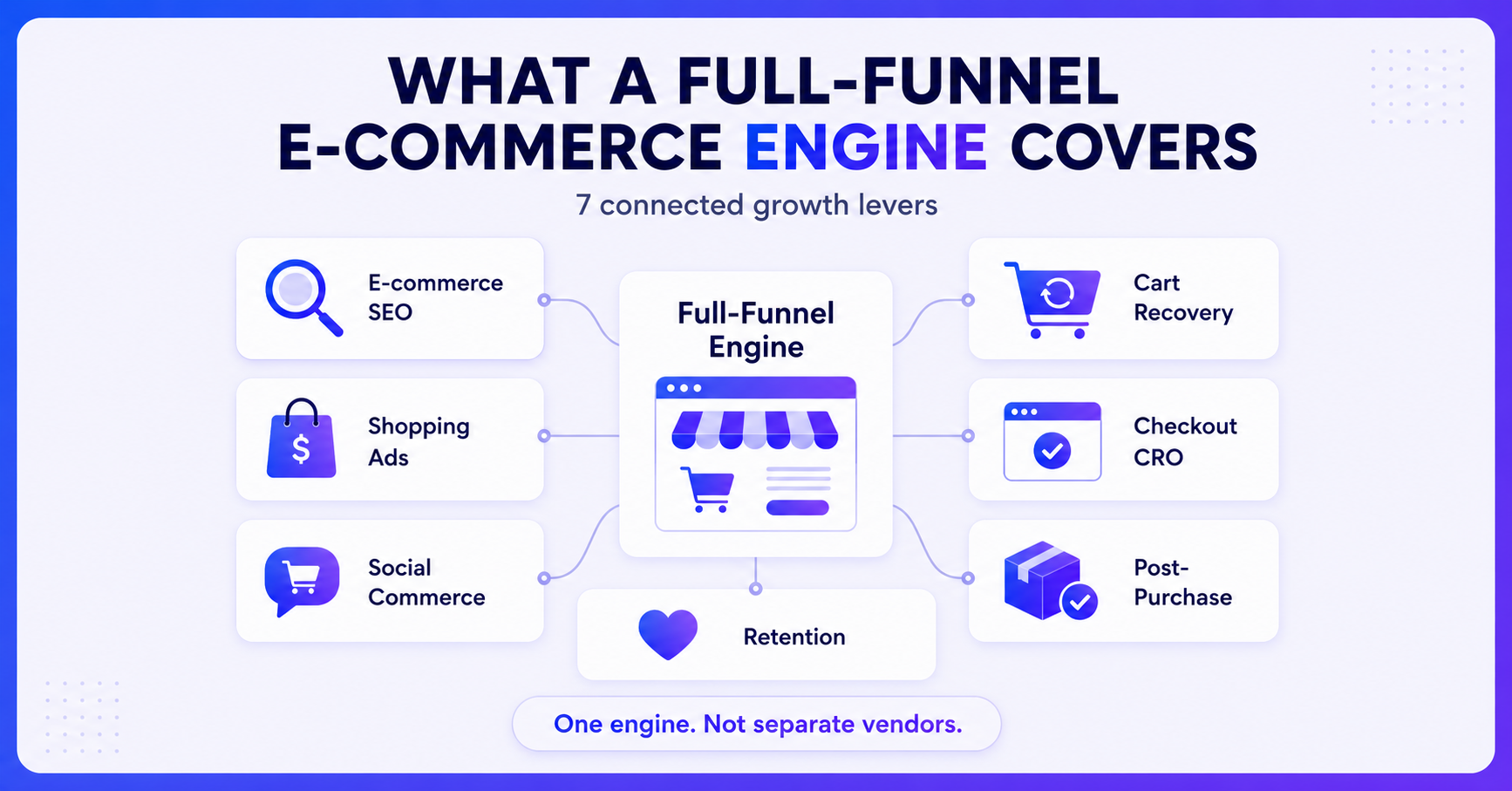
A results-driven e-commerce program, whether you're running on Shopify, WooCommerce, Magento, BigCommerce, or a custom-built store, typically covers seven interconnected pillars:
1. E-commerce SEO
This means optimizing product titles, descriptions, images, and category pages specifically to rank for transactional, buy-intent keywords the kind of search a customer types right before they purchase, not just when they're browsing. SEO for e-commerce is less about generic informational content and more about capturing demand that's already looking to convert.
2. Google Shopping Ads (PLA)
Product Listing Ads put your product's image, price, and reviews directly in front of shoppers on Google often before they even click through to a website. This requires optimized product feeds and carefully structured Shopping campaigns, since feed quality has a direct impact on how often and how prominently your products appear.
3. Social Commerce (Facebook & Instagram Shops)
Increasingly, purchases happen without a customer ever leaving the app. Connecting your product catalog to Facebook and Instagram Shops means customers can discover and buy products right where they're already scrolling, reducing friction and shortening the path from discovery to purchase.
4. Abandoned Cart Email & SMS Recovery
The majority of online shopping carts are abandoned before checkout is completed which makes cart recovery one of the highest-ROI tactics in e-commerce. Automated sequences typically fire at staged intervals: a first email around an hour after abandonment, a second roughly 24 hours later, and a third at 48 hours, often paired with SMS recovery for mobile shoppers. Done well, this alone recovers meaningful revenue that would otherwise simply disappear.
5. Post-Purchase Email Sequences
The relationship shouldn't end at checkout. Post-purchase sequences handle upsells, cross-sells, and review requests, extending the value of every customer you've already paid to acquire and building the kind of feedback and social proof that fuels future sales.
6. CRO for Checkout
Even great traffic and great products fail if your product pages, cart, and checkout flow create friction. Conversion Rate Optimization means redesigning these exact moments where customers are most likely to drop off to systematically reduce abandonment and lift conversion rate across the board.
7. Customer Retention (Loyalty & Referral Programs)
Acquiring a new customer is almost always more expensive than keeping one. Loyalty points, referral programs, and win-back campaigns are built specifically to increase repeat purchase rate, which has an outsized impact on long-term profitability compared to constantly chasing first-time buyers.
Why Traffic Alone Is the Wrong Goal
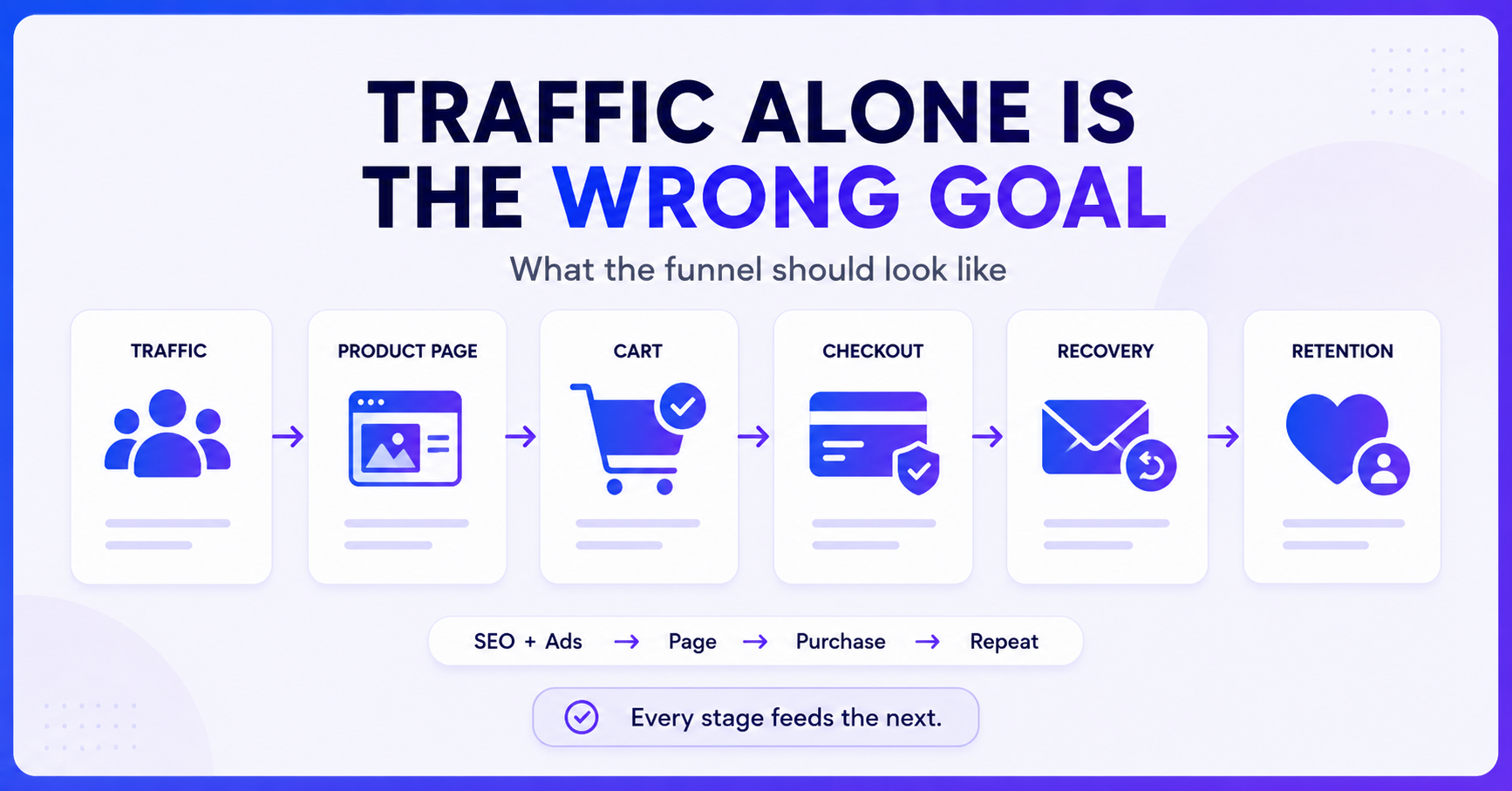
A common trap for growing stores is optimizing purely for traffic volume. But traffic without a system to convert, recover, and retain it is inefficient at best and unprofitable at worst. A properly built funnel looks more like this:
Traffic (SEO + Shopping ads) → Product Page (SEO copy, strong imagery) → Cart (retarget if abandoned) → Checkout (CRO to reduce drop-off) → Cart Recovery (email + SMS sequence) → Retention (post-purchase, loyalty)
Every stage feeds the next. Strong SEO and Shopping ads mean nothing if the product page doesn't convert. A great product page means nothing if checkout friction causes drop-off. And a completed sale means nothing for long-term growth if there's no retention strategy bringing that customer back. This is precisely why fragmented, single-channel marketing underperforms compared to a connected, full-funnel approach.
How the Discovery & Execution Process Should Work
Discovery & Research Phase
Before any campaign launches, a proper audit examines your entire funnel: product page conversion rate, checkout drop-off points, abandoned cart rate, and customer lifetime value. This is paired with research into competitors' ad strategy, pricing, and email sequences. The output should be a specific e-commerce growth plan detailing exactly what actions will increase traffic, conversion rate, and average order value not generic recommendations.
Execution Timeline
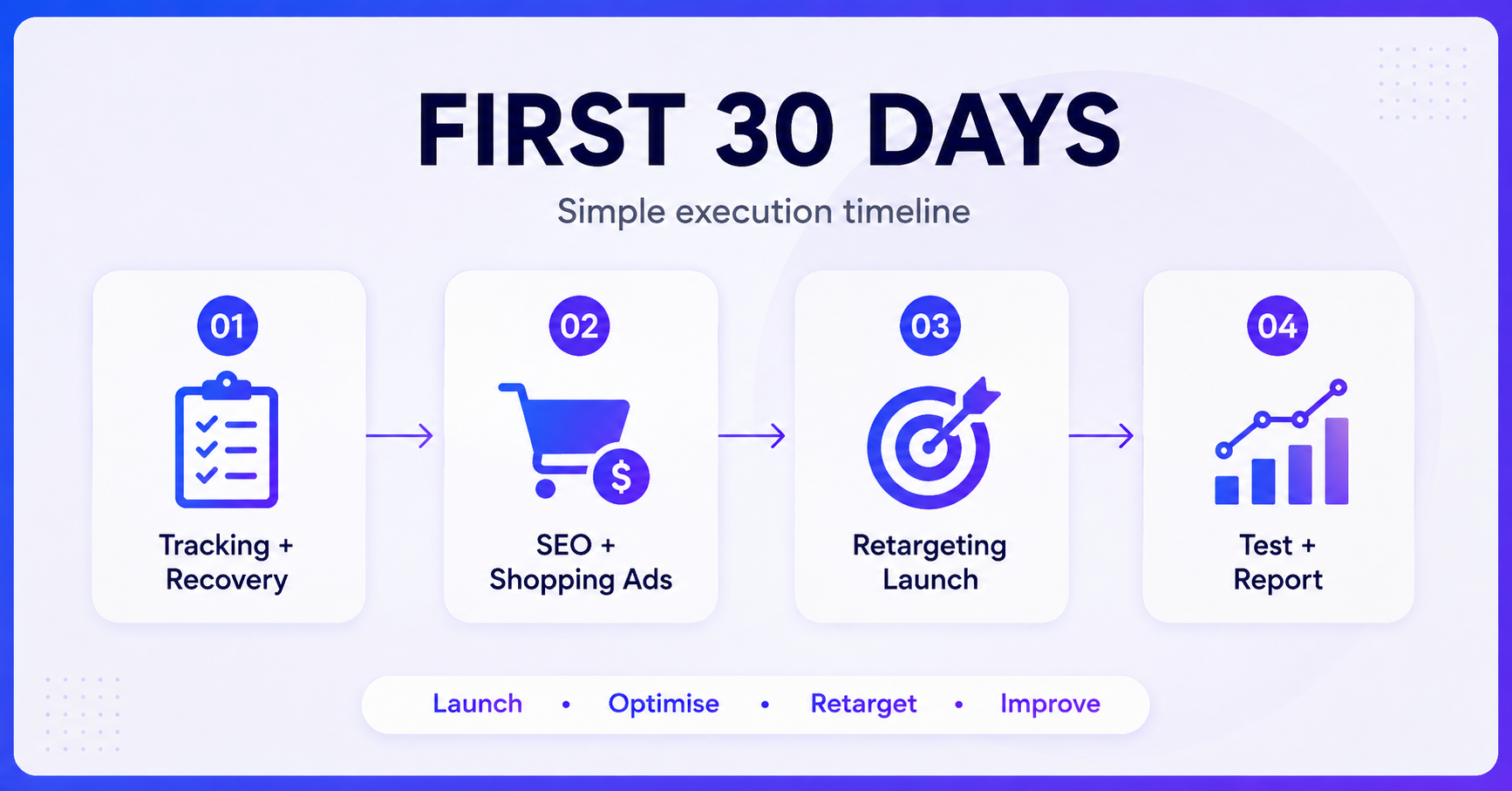
A structured first-month rollout typically looks like:
-
Week 1: Fix tracking (GA4, conversion tracking, enhanced e-commerce) and set up abandoned cart email sequences
-
Week 2: Optimize the top 10 product pages for SEO and launch Google Shopping Ads with a small test budget
-
Week 3: Launch retargeting ads on Facebook and Instagram aimed at product viewers who didn't purchase
-
Week 4 and beyond: A/B test product pages, email subject lines, and ad creatives, with weekly reports covering sales, ad spend, and ROAS
Metrics That Actually Determine E-commerce Success
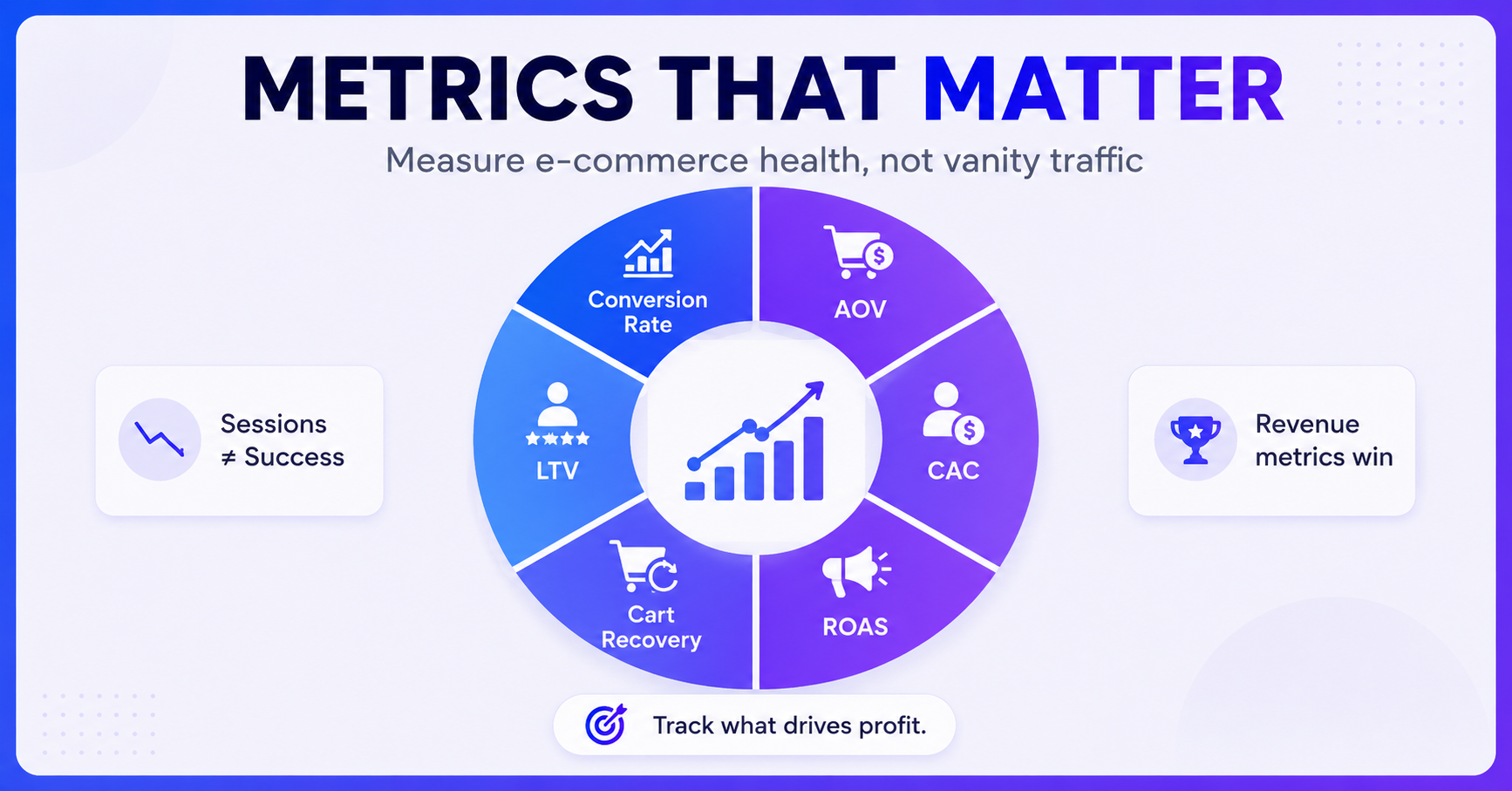
Vanity metrics like impressions or raw sessions rarely tell the full story. The metrics that matter for e-commerce growth include:
-
Conversion Rate (Overall) the percentage of visitors who actually purchase
-
Average Order Value (AOV) how much each transaction is worth, which compounds with volume
-
Customer Acquisition Cost (CAC) what it actually costs to win a new customer
-
Return on Ad Spend (ROAS) the direct efficiency of every advertising rupee
-
Abandoned Cart Recovery Rate how much "lost" revenue is actually being reclaimed
-
Customer Lifetime Value (LTV) the true long-term value of each customer relationship, not just their first order
Tracking these consistently and having a live dashboard rather than a monthly PDF is what allows a store to make fast, informed decisions instead of guessing.
What Results Look Like When the Funnel Works Together
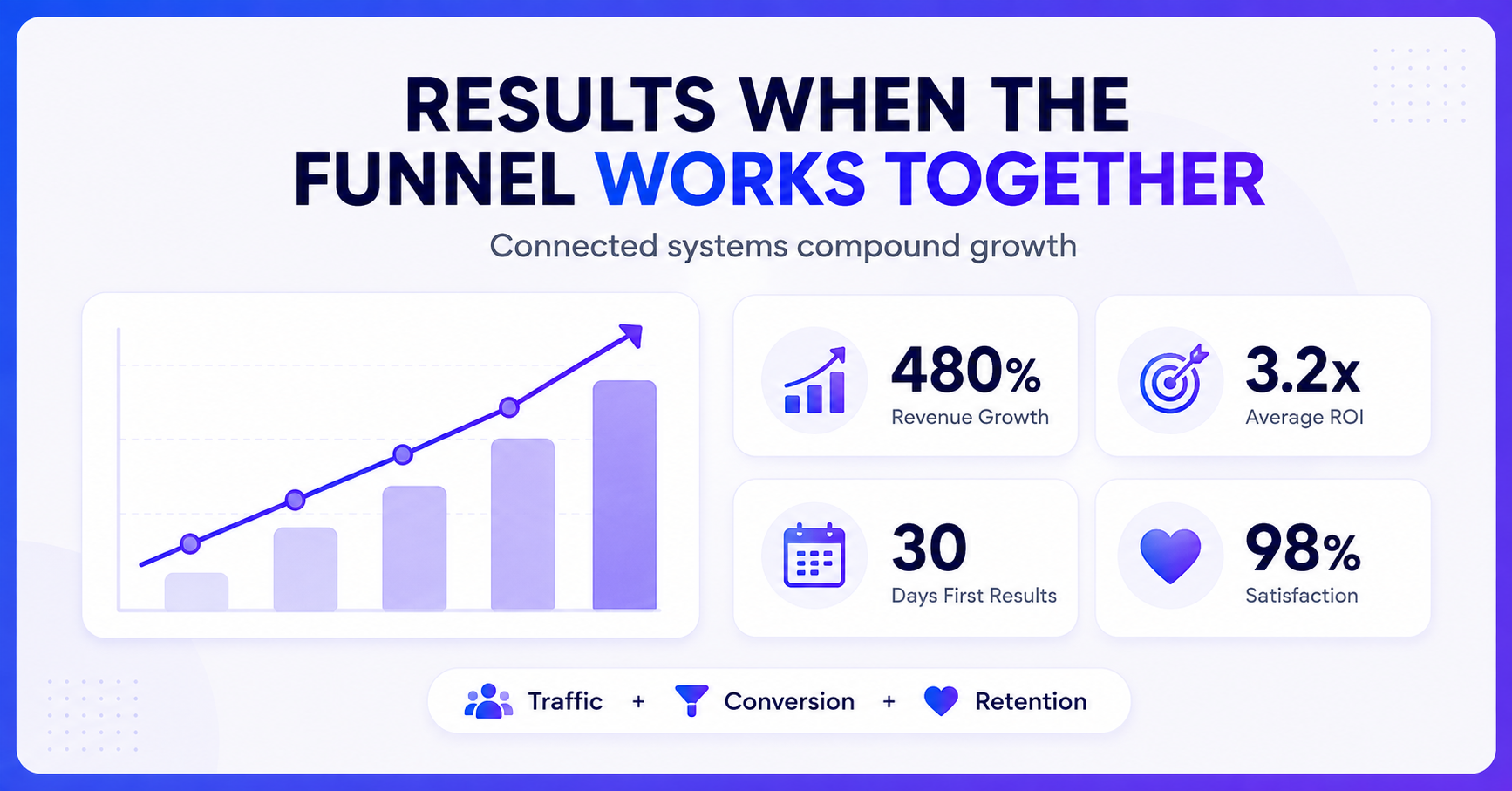
When SEO, Shopping ads, social commerce, cart recovery, CRO, and retention are engineered as one system rather than separate initiatives, the compounding effect shows up quickly. Stores running a full 6-month e-commerce marketing engagement have seen an average revenue growth of 480%, an average ROI of 3.2x, and first measurable results within 30 days, with client satisfaction rates around 98%.
A notable example is an 8-month e-commerce campaign for an Indian fashion D2C brand that reached ₹2 Crore in monthly revenue, 480% revenue growth, 2.1 million in monthly reach, and a 3.2x ROAS the direct result of traffic, conversion, recovery, and retention all being optimized in parallel rather than in isolation.
Common Questions About E-commerce Marketing
- Which e-commerce platforms are supported?
A capable e-commerce marketing partner should work across Shopify, WooCommerce (WordPress), Magento, BigCommerce, and custom-built stores the strategy adapts to your platform, not the other way around.
2. Do you manage Amazon or Flipkart marketplace ads?
Most full-funnel e-commerce marketing engagements focus specifically on D2C stores your own website since marketplace advertising is a distinct discipline with its own algorithms and rules. For marketplace ads, it's usually best to work with a specialized partner alongside your D2C strategy.
3. How exactly do you recover abandoned carts?
Through automated, staged email sequences typically a first email about an hour after abandonment, a second at 24 hours, and a third at 48 hours combined with SMS recovery to reach mobile shoppers who are more likely to respond to a text than dig through their inbox.
4. Can an agency help with product page copy and images?
Yes conversion-optimized product descriptions and bullet points are a core part of product page SEO and CRO, along with recommendations for product photography and video that reduce hesitation at the point of purchase.
Choosing the Right E-commerce Marketing Partner
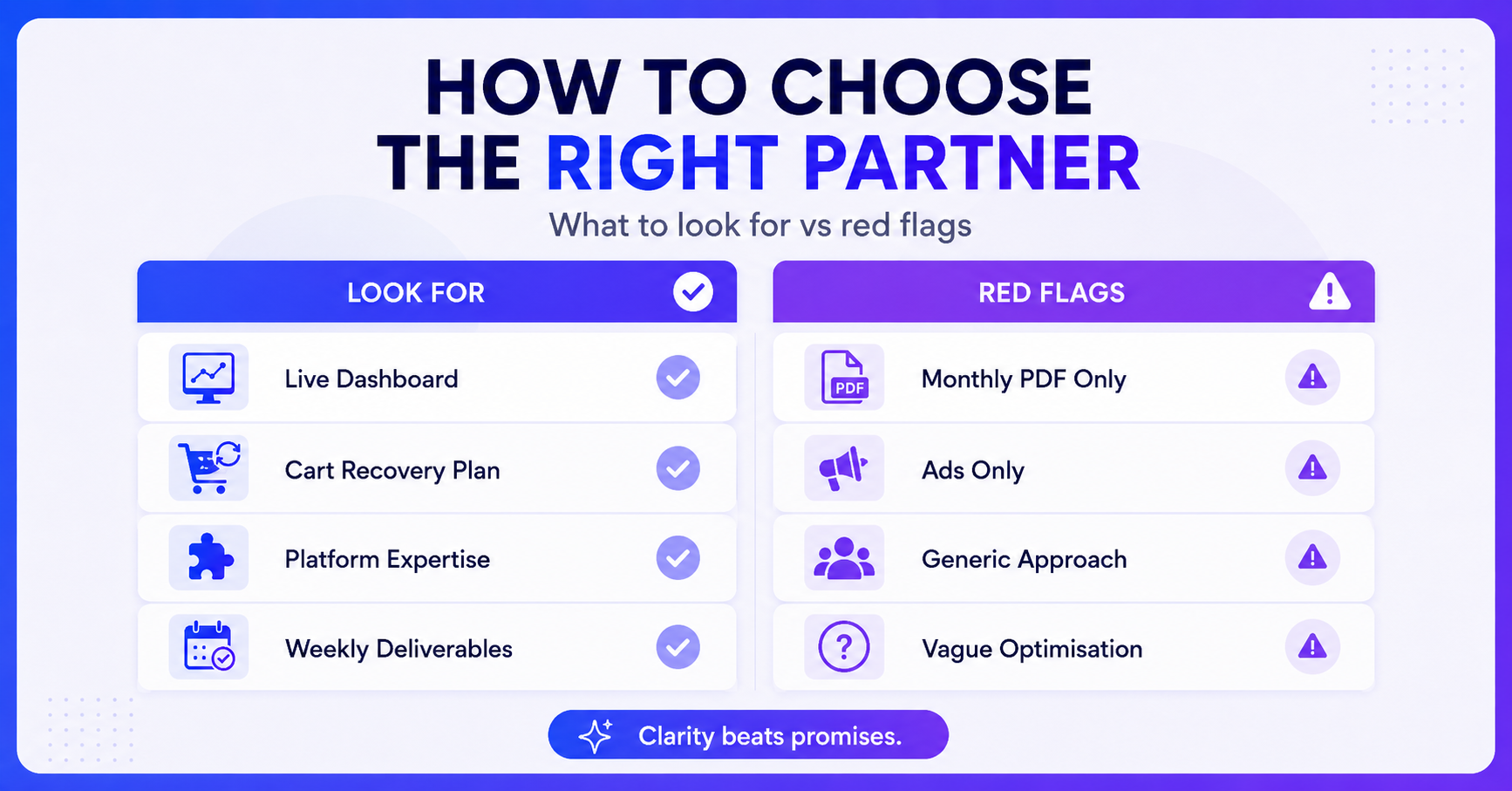
Not every agency that claims to "do e-commerce" actually runs a connected funnel. When evaluating a potential partner, look for:
-
A live dashboard showing real sales, ad spend, and ROAS not a monthly summary you have to wait for
-
A documented cart recovery and retention strategy, not just top-of-funnel ad management
-
Platform-specific experience with your store's tech stack
-
A clear execution timeline with defined weekly deliverables, not vague "ongoing optimization"
-
Transparent reporting tied to the metrics that actually matter: AOV, CAC, ROAS, and LTV not just clicks and impressions
Final Thoughts
Scaling an online store was never going to be solved by one tactic. SEO brings in buy-intent traffic, Shopping ads and social commerce meet customers where they already are, cart recovery reclaims revenue that would otherwise vanish, CRO removes friction at checkout, and retention programs turn one-time buyers into repeat customers. When all of these work together as a single, connected system, a store stops leaking revenue at every stage and starts compounding growth month over month.
If your store's traffic isn't translating into the sales it should, working with a full-funnel e-commerce marketing agency one that treats SEO, ads, email, and checkout optimization as one engine instead of five separate vendors is often the fastest way to close that gap.
Ready to see what a full-funnel e-commerce engine could do for your store? Book a free 30-minute strategy call and get a growth plan built around your specific funnel.