A few years ago, if someone searched for “best digital marketing agency in Noida,” they would usually open Google, scan the first page and click on a few websites before making a decision.
That search journey is changing.
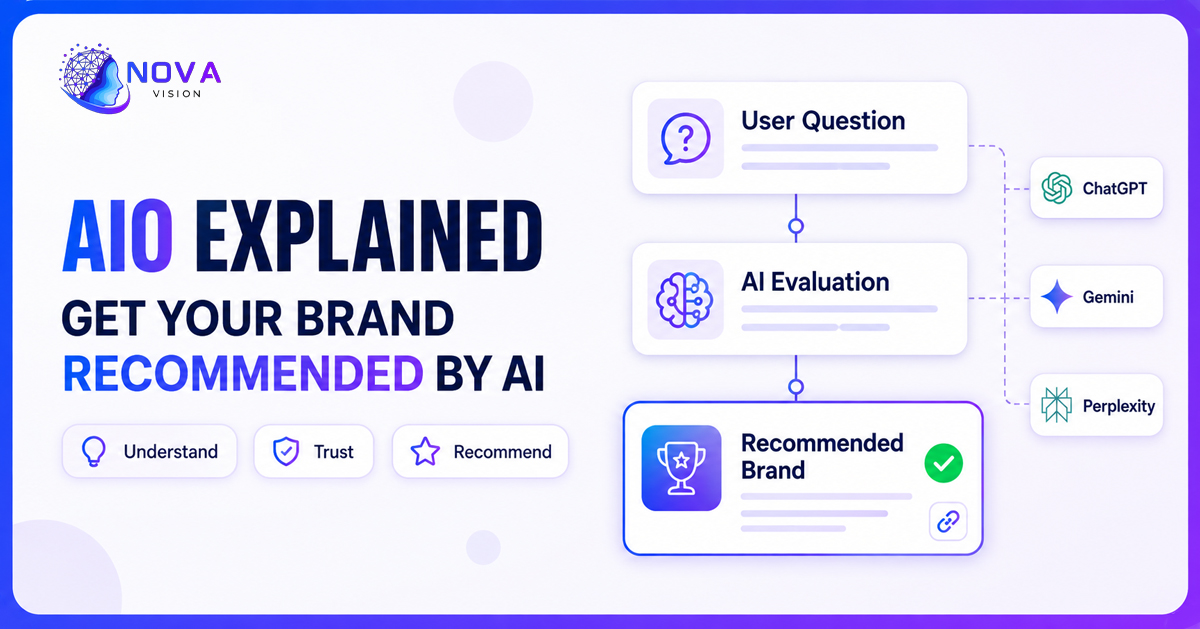
Today, the same person might ask ChatGPT, Gemini or Perplexity, “Which is the best digital marketing agency in Noida?” Instead of showing ten blue links, the AI may give them a short list of businesses it considers relevant.
If your business is not mentioned in that answer, you may never get the chance to be considered.
This is where Answer Engine Optimization (AEO) and AI Optimization (AIO) are becoming important. They don't replace traditional SEO. Instead, they build on it and help your business stay visible as search becomes more conversational and AI-driven.
Let's look at what AEO and AIO actually mean, how they differ from SEO, and what businesses can do to improve their chances of appearing in AI-generated answers.
How Search Behaviour Has Changed
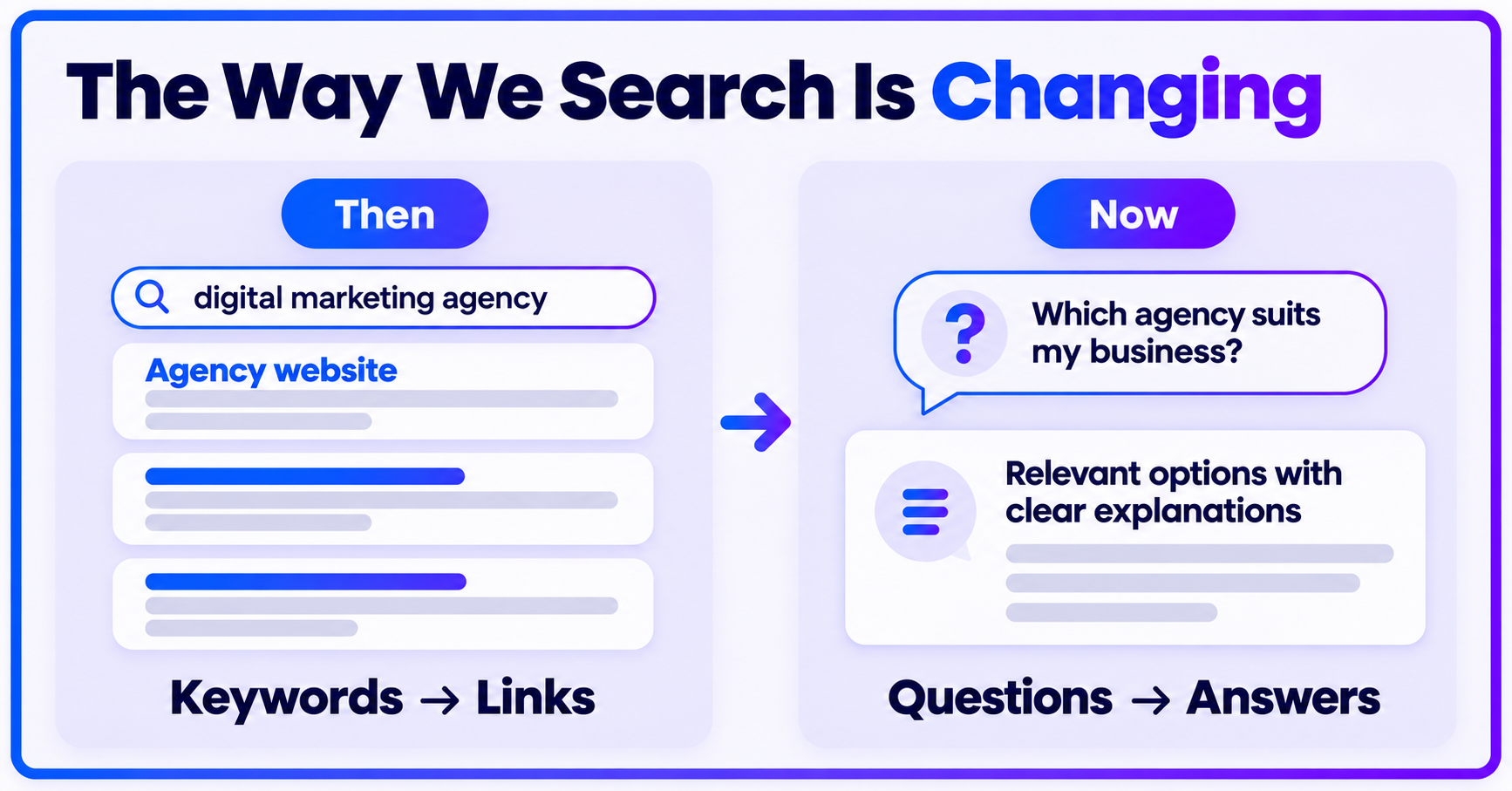
Search was once fairly straightforward.
You typed a keyword into Google, Google showed you a list of results, and you decided which website to visit.
Now, people are increasingly searching by asking complete questions. They might ask:
-
Which CRM is best for a small real estate team?
-
How can I generate more leads for my clinic?
-
What is the best digital marketing agency for a local business?
-
Which software is better for a small business?
AI search tools can understand the context behind these questions and provide a direct response.
Google is also moving in this direction with AI Overviews, while tools such as ChatGPT, Gemini and Perplexity are making conversational search more common.
This creates a few important changes.
Fewer clicks can mean more importance for each mention. If an AI gives someone three recommendations instead of ten search results, being one of those three can make a big difference.
Search queries are becoming more specific. People are explaining what they need instead of simply typing two or three keywords.
Trust matters more than ever. AI systems need to decide which businesses and sources are reliable enough to include in an answer.
This doesn't mean SEO is going away. It means businesses now need to think beyond rankings alone.
What Is AEO (Answer Engine Optimization)?
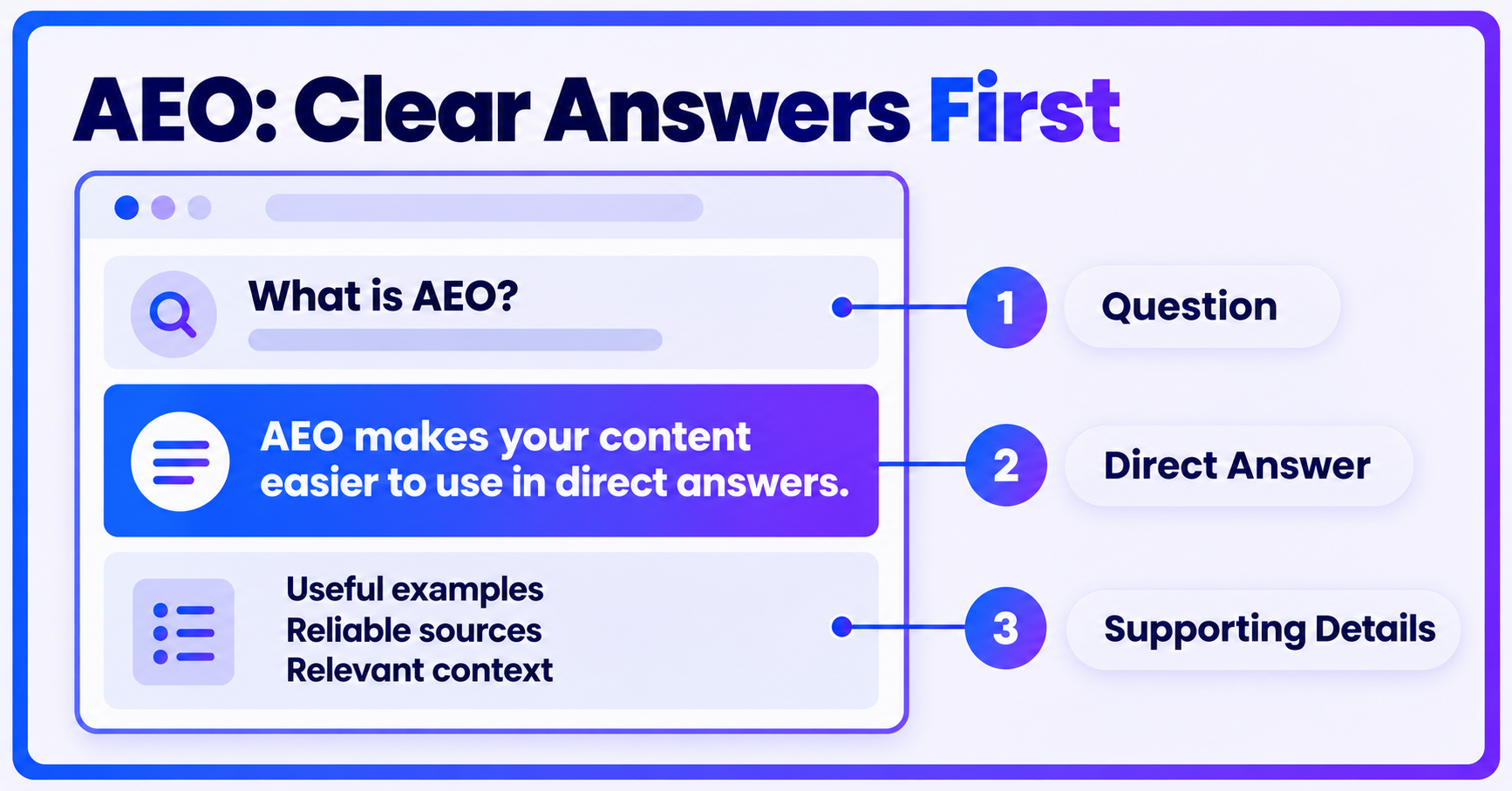
Answer Engine Optimization, or AEO, focuses on making your content easy for search engines and answer engines to understand and use when answering questions.
The idea is simple: give a clear and useful answer to the question the user is asking.
AEO can help content become eligible for things such as featured snippets, People Also Ask results, voice-search answers and other search features.
A page designed with AEO in mind may include:
-
A question-based heading
-
A short and direct answer near the beginning
-
Detailed information supporting that answer
-
Examples, statistics or relevant context
-
Appropriate structured data
For example, instead of writing a long introduction before answering “What is technical SEO?”, an AEO-friendly page could answer the question immediately and then explain the topic in more detail.
Think of it this way:
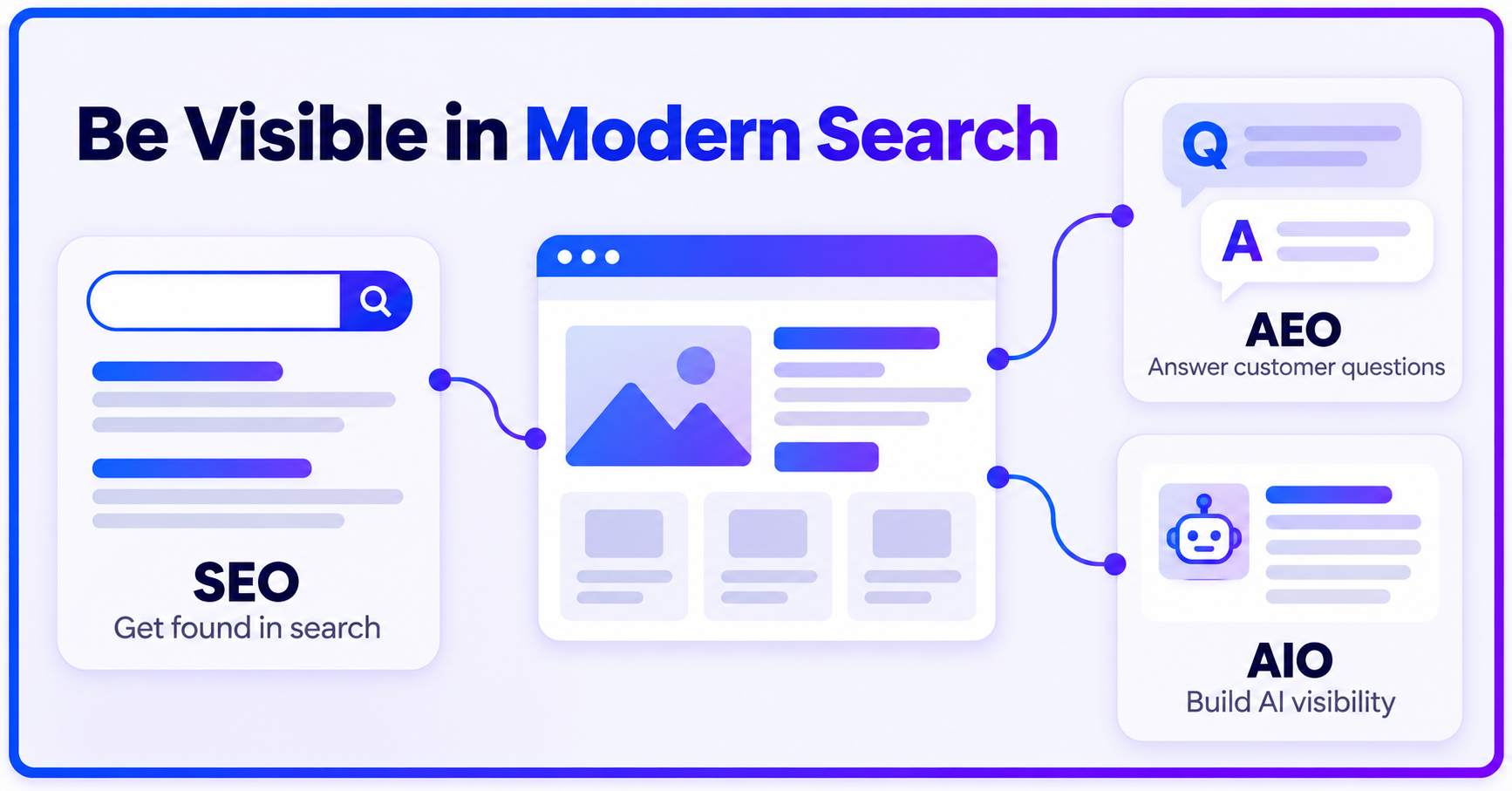
SEO helps people find your page. AEO makes your answer easier to find and understand.
What Is AIO (AI Optimization)?
AIO, or AI Optimization, takes the idea a little further.
The goal is to make your business easier for generative AI systems such as ChatGPT, Gemini, Perplexity, Claude and Microsoft Copilot to understand when they are answering questions related to your industry.
This isn't only about one website page.
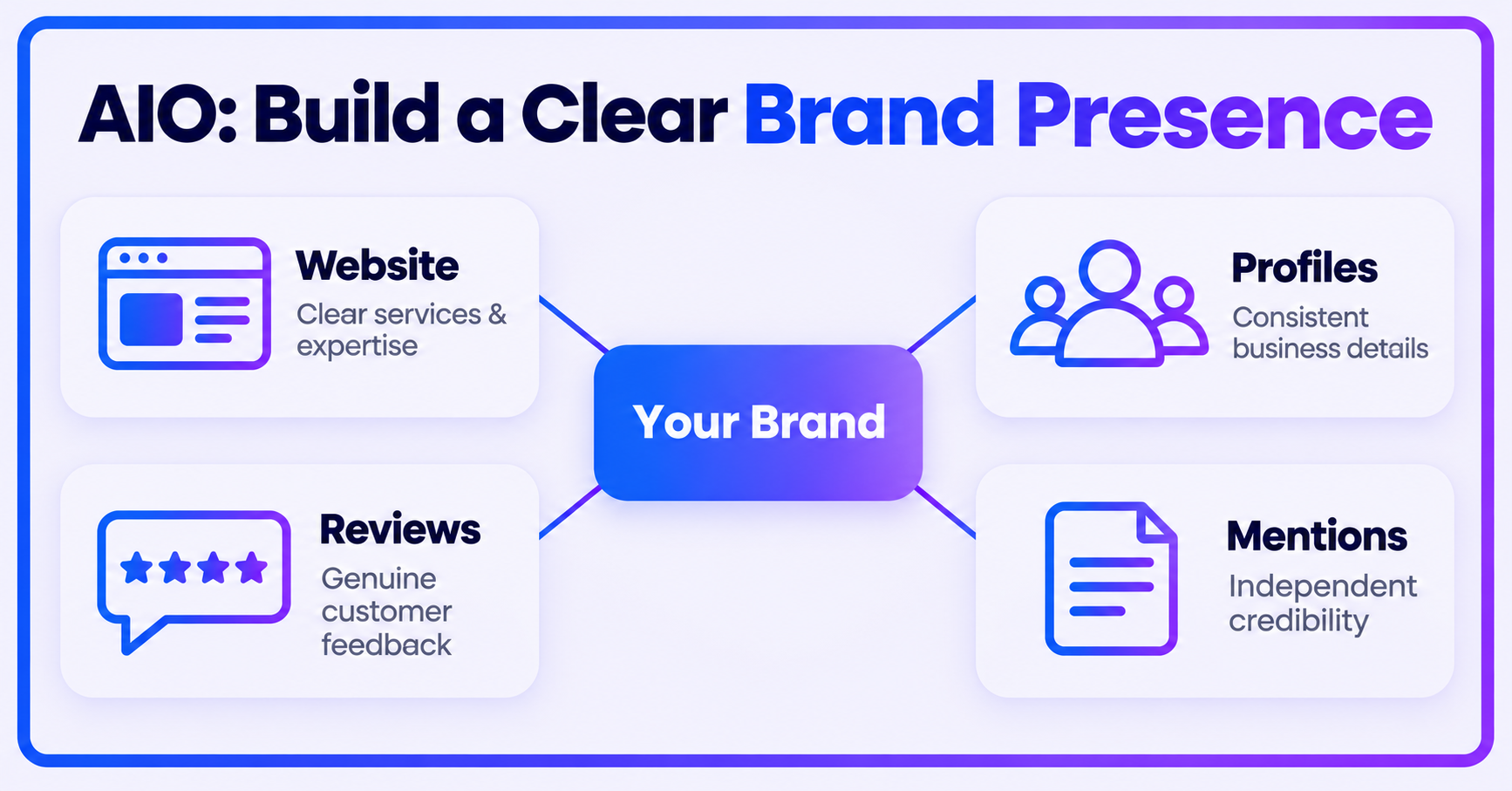
AI systems can use information from many different places when forming an understanding of a business. This can include your website, business profiles, reviews, directories, social media, articles, mentions and other trusted sources.
For example, imagine two agencies offering similar SEO services.
Agency A has a basic website with very little information and almost no independent mentions online.
Agency B has a detailed website, consistent business information, strong reviews, useful industry content, case studies and mentions on relevant websites.
The second business gives AI systems much more information from which to understand its expertise and reputation.
That is where AIO becomes important.
AEO vs SEO vs AIO: What's the Difference?
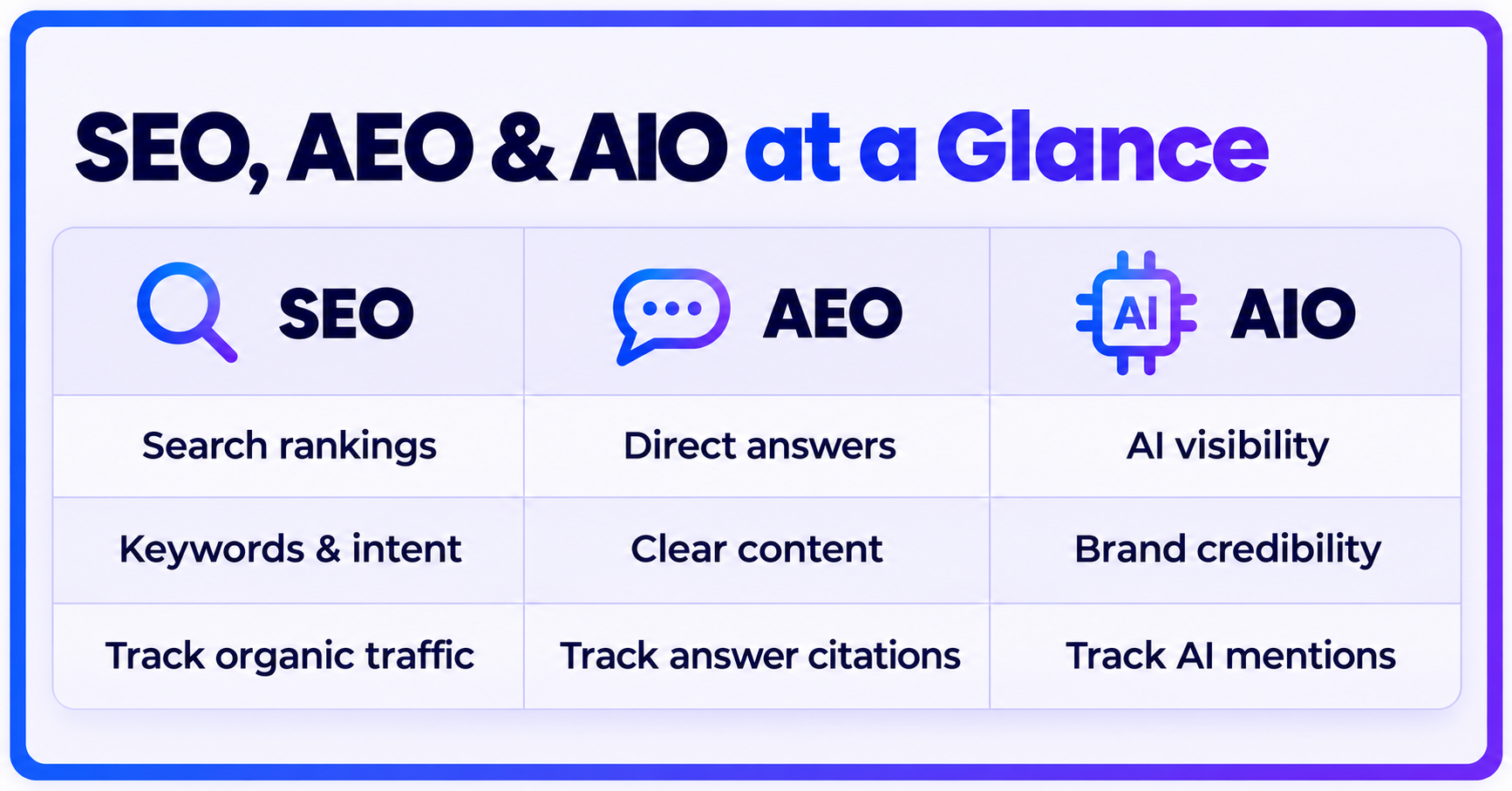
| SEO | AEO | AIO |
|---|---|---|
| Focuses on search rankings | Focuses on direct answers | Focuses on AI visibility and recommendations |
| Keywords and search intent | Questions and answer-focused content | Brand authority and entity understanding |
| Technical SEO and backlinks | Snippets and structured content | Reputation and trust signals |
| Success = rankings and organic traffic | Success = answer visibility and citations | Success = mentions in AI-generated answers |
These three approaches work together rather than competing with each other.
SEO creates the foundation. AEO makes your content easier to understand and extract. AIO strengthens your overall brand presence across the web.
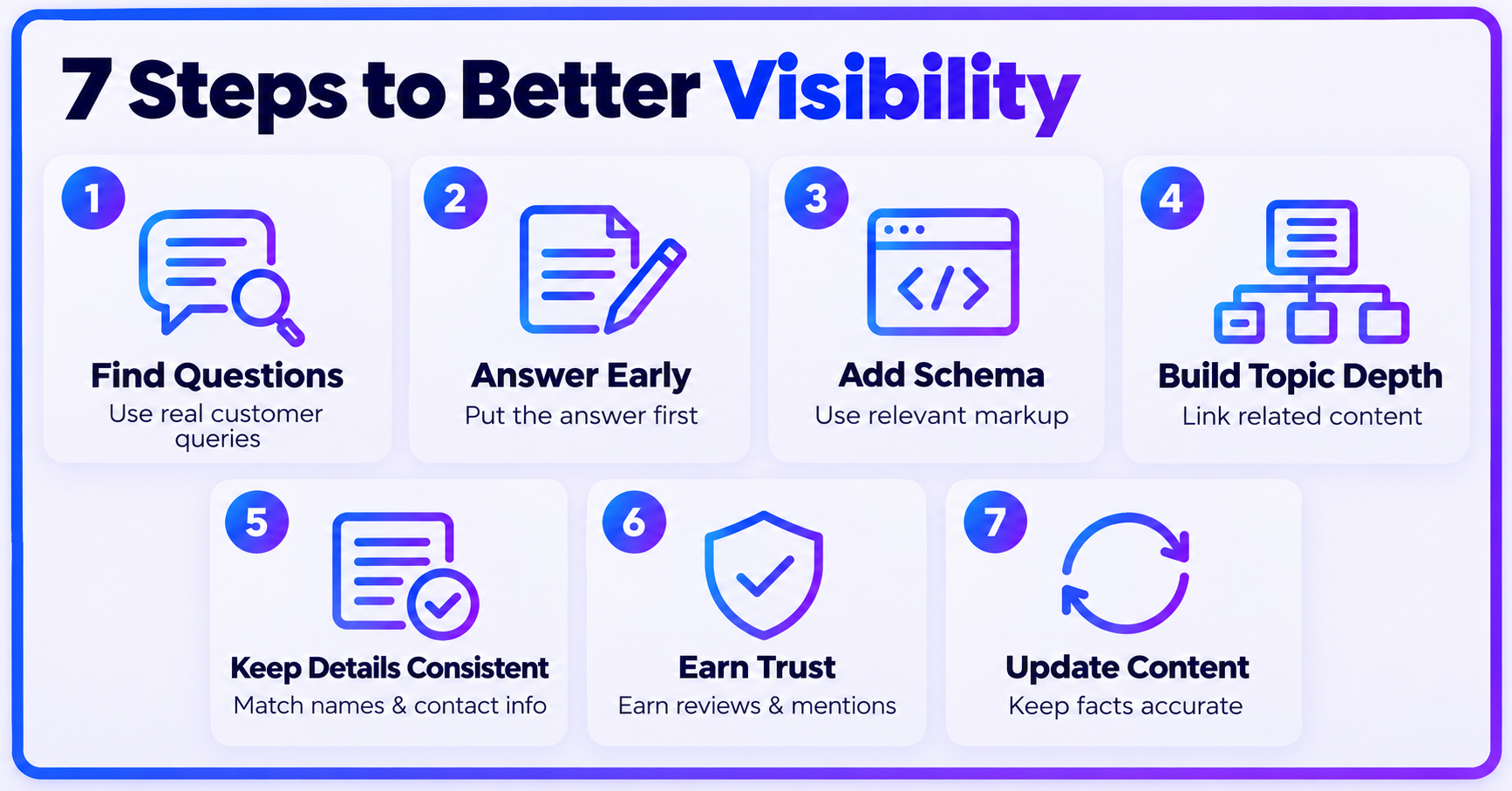
7 Practical Steps to Get Started
1. Find the questions your customers actually ask
Start with your customers, not just a keyword research tool.
Think about the questions people ask before contacting your business. These could be about pricing, services, timelines, comparisons, problems, alternatives or results.
Your sales calls, WhatsApp conversations, Google Search Console queries, customer emails and People Also Ask results can give you plenty of ideas.
Every useful question can become a section on an existing page, an FAQ or even a complete article.
2. Give the answer early
Don't make readers go through five paragraphs before they reach the answer.
If your heading is “What is AEO?”, answer that question immediately. You can then explain the topic, provide examples and add supporting information underneath.
This approach is better for users because they can quickly understand the point. It also gives search engines and AI systems clear information to work with.
3. Use structured data where it makes sense
Schema markup helps search engines understand the information on your website.
Depending on the page, this might include Organization, LocalBusiness, Service, Article or other relevant schema types.
Schema alone won't guarantee that your business will appear in an AI answer. However, it can make your website's information easier for search engines to interpret.
The important thing is to use relevant schema correctly rather than adding markup simply for the sake of it.
4. Build depth around your main topics
One blog post is rarely enough to establish strong topical authority.
If you offer digital marketing services, for example, don't publish only one article about SEO. Build useful content around related topics such as technical SEO, local SEO, content marketing, AEO, Google Ads, link building, SEO reporting and lead generation.
Connect these pages through internal links.
Over time, this creates a useful content network instead of a collection of unrelated blog posts.
5. Make your brand information consistent
Your business details should not look different everywhere.
Keep your business name, address, phone number, website, services and company description consistent across your website, Google Business Profile, LinkedIn, directories and other important platforms.
This is particularly important for local businesses.
When information is consistent across multiple sources, it becomes easier for search engines and AI systems to understand that those different profiles belong to the same business.
6. Build credibility outside your website
Your own website can tell people that you are an expert. But independent proof is much stronger.
Reviews, genuine customer testimonials, case studies, industry publications, guest contributions, interviews, podcasts and relevant business mentions can all help strengthen your online reputation.
The goal shouldn't be to collect random mentions just to manipulate AI results.
Focus on being visible in places where your customers and industry actually spend time.
7. Keep your content accurate and updated
Old or inaccurate content can hurt both users and your brand.
Review important pages regularly. Update outdated statistics, remove information that is no longer relevant and make sure your claims can be supported.
It also helps to show who created the content and why they are qualified to discuss the subject, particularly for topics where experience and expertise matter.
Good content isn't just content that ranks. It should continue to be useful when someone reads it months later.
Common AEO and AIO Mistakes to Avoid
Treating AEO like a shortcut
There is no magic trick that guarantees an AI recommendation.
Trying to stuff every possible question into a page or repeatedly mentioning your company name isn't a sustainable strategy.
Useful content and genuine authority matter more.
Abandoning traditional SEO
AEO and AIO don't make SEO irrelevant.
Technical performance, crawlability, useful content, internal linking, backlinks, search intent and a good user experience still matter.
A strong SEO foundation can support your visibility across both traditional and AI-powered search.
Writing only for machines
It is easy to overdo question-based content.
If every heading sounds unnatural and every paragraph is written around a keyword, the page becomes difficult to read.
Write for the person first. Then structure the content so search engines and AI systems can understand it easily.
Ignoring local search signals
For local businesses, location still matters.
A complete Google Business Profile, genuine local reviews, consistent business information and useful location-specific content can all contribute to stronger local visibility.
If you want an AI tool to recommend your business in Noida, for example, it should be very clear that your business actually serves Noida.
Expecting results overnight
AI visibility is not something you can build in a few days.
It takes time to develop useful content, earn mentions, improve your reputation and create a consistent digital presence.
Instead of looking only at rankings, track things such as branded searches, organic traffic, featured snippets, AI citations, qualified leads and the questions bringing people to your website.
Who Needs AEO and AIO Most?
Almost any business can benefit from these strategies, but they can be especially useful for businesses where customers spend time researching before making a decision.
This includes:
-
Local service businesses
-
Digital marketing and professional service companies
-
Real estate businesses
-
Clinics and healthcare providers
-
Legal and financial firms
-
Education providers
-
B2B companies
-
E-commerce brands
-
Agencies and consultants
If your potential customers regularly ask questions before contacting you, there is a good chance they are already using search engines or AI tools to find those answers.
How Nova Vision Mediatech Can Help
At Nova Vision Mediatech, we don't treat AEO and AIO as separate activities that sit outside SEO.
Instead, we look at them as part of a broader digital growth strategy.
Our Noida-based team combines SEO, content strategy, technical optimisation and online brand building to help businesses improve their visibility across traditional search as well as AI-driven search experiences.
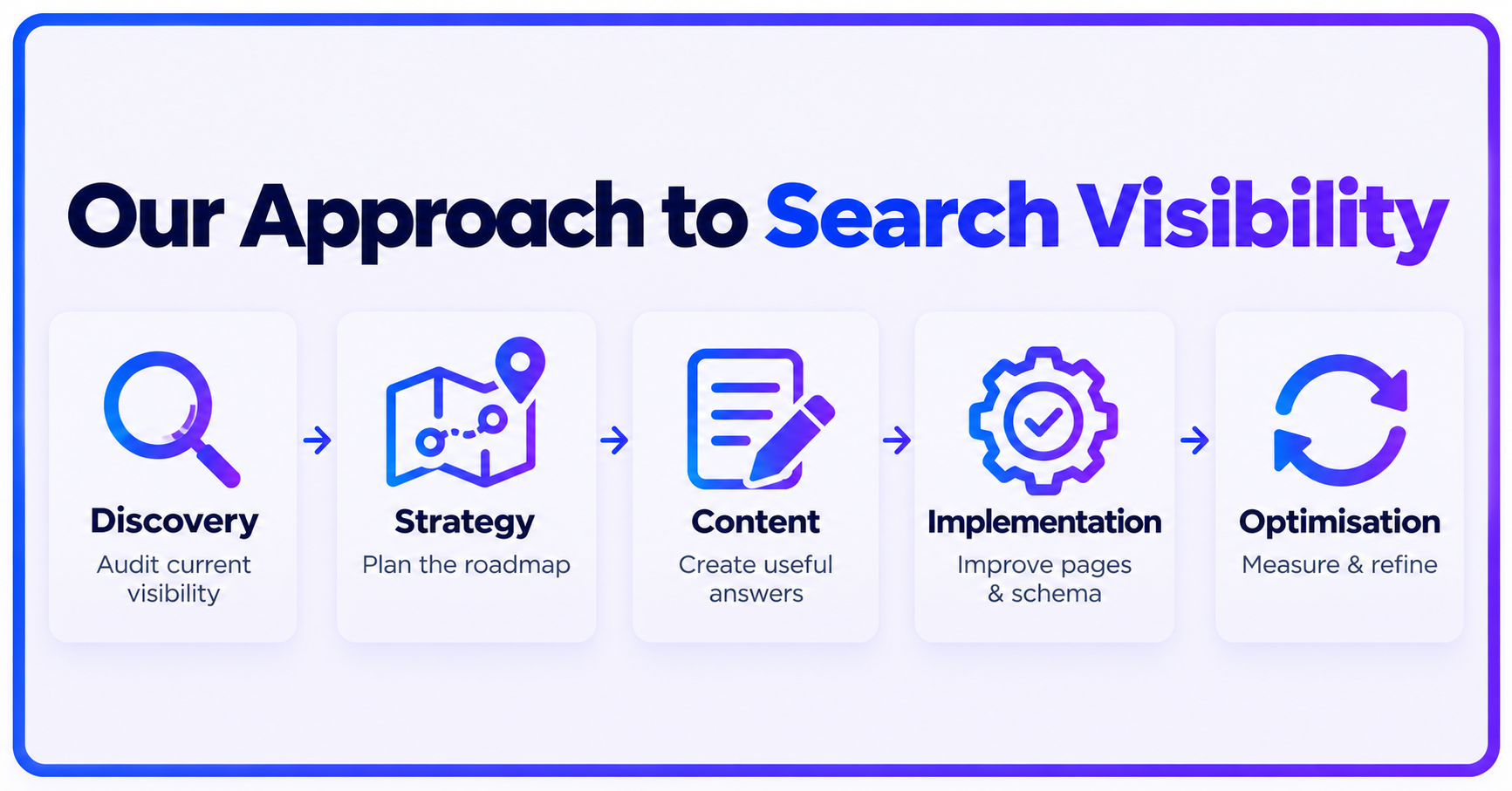
Our process starts with understanding where your business currently stands and where the biggest opportunities are.
Discovery
We review your current search visibility, competitors, website and the questions your potential customers are searching for.
Strategy
We create a practical roadmap covering SEO, AEO and AIO based on your business goals, audience and budget.
Content Creation
We develop useful, answer-focused content and optimise important service and landing pages so they are easier for both users and search engines to understand.
Implementation
We put the strategy into action, including technical improvements, content optimisation, structured data and tracking.
Continuous Optimisation
Search behaviour keeps changing, so the work doesn't stop after the initial implementation. We monitor performance, identify opportunities and focus more on the strategies that are producing meaningful results.
With experience across 250+ projects and a team working across SEO, Google Ads, social media, web development and video, our focus is not simply on increasing impressions.
The bigger goal is to turn visibility into relevant traffic, leads and business growth.
Final Thoughts
The way people search for businesses is changing.
People are asking longer questions, using conversational search and increasingly relying on AI tools to research products, services and companies.
That doesn't mean traditional SEO is finished.
It means businesses need to think beyond rankings.
Your website needs to answer questions clearly. Your content needs to demonstrate real expertise. Your business information needs to be consistent. And your reputation needs to extend beyond your own website.
SEO, AEO and AIO work best when they are treated as different parts of the same strategy.
The businesses that start building this foundation now will have a better chance of being visible when customers ask, “Which company should I choose?”
If you're wondering how visible your business is across traditional and AI search, Nova Vision Mediatech can help you identify the gaps and build a practical strategy around them.
Get in touch with Nova Vision Mediatech to explore how your business can become easier to find, understand and recommend across modern search.