In today's competitive digital marketplace, businesses are constantly looking for effective ways to generate high-quality leads and increase sales. Among the many online advertising platforms available, Google Ads and Facebook Ads remain the two most powerful options. Both platforms offer unique advantages, extensive audience reach, and sophisticated targeting capabilities, making them essential tools in modern digital marketing strategies.
However, one common question businesses ask is: Which platform is better for lead generation—Google Ads or Facebook Ads?
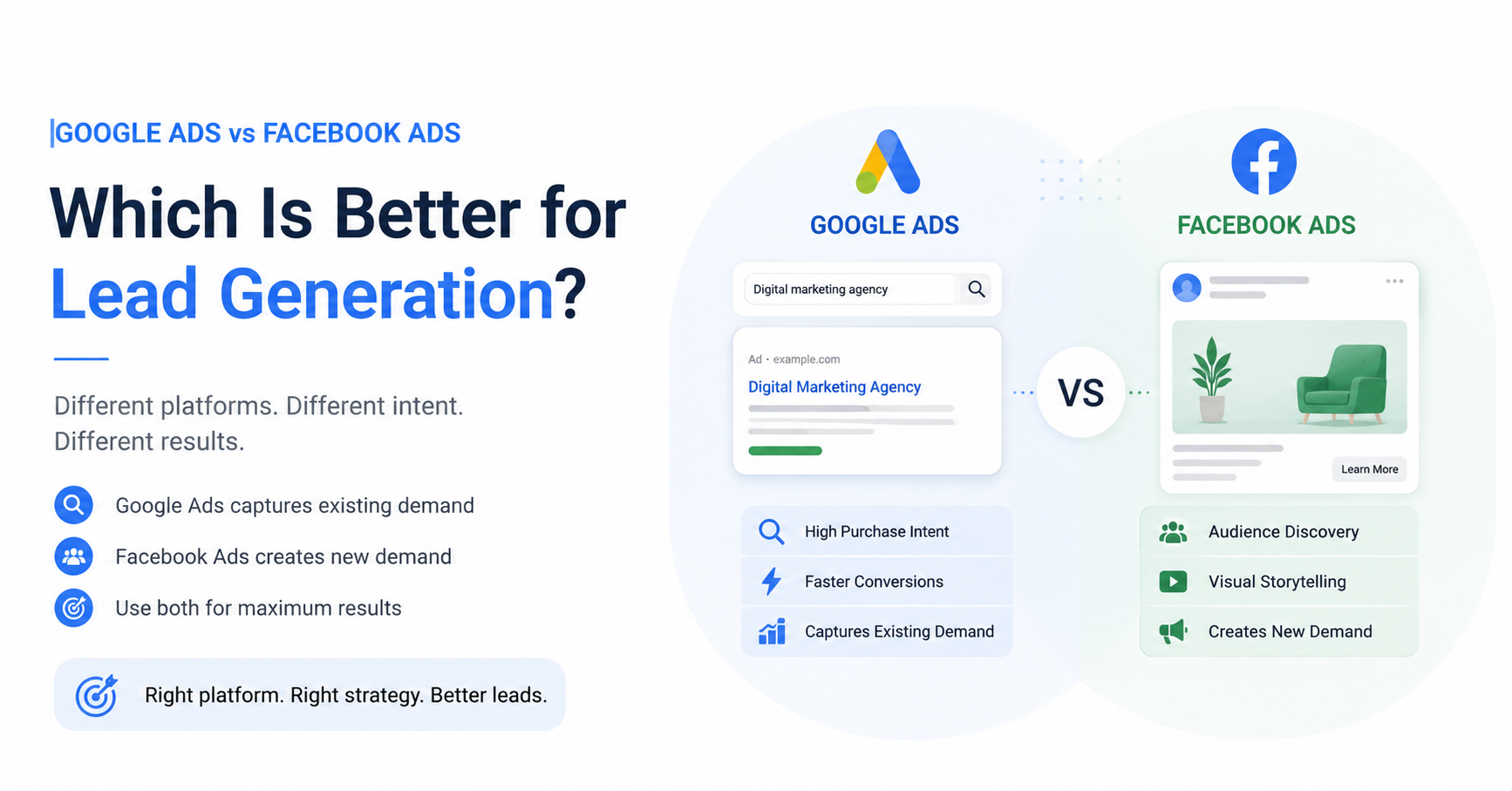
The answer depends on your business goals, target audience, budget, and industry. While Google Ads excels at capturing users with high purchase intent, Facebook Ads shines at creating demand and building brand awareness through highly targeted audience segmentation. Industry analyses consistently describe Google as intent-based advertising and Facebook as interest-based advertising.
At Nova Vision, we understand that there is no one-size-fits-all approach to digital advertising. Our experts analyze your business objectives, customer behavior, and market competition to determine whether Google Ads, Facebook Ads, or a combination of both will deliver the best lead generation results. By creating customized advertising strategies, Nova Vision helps businesses achieve sustainable growth and long-term success in the digital landscape.
Understanding Google Ads
Google Ads is Google's pay-per-click (PPC) advertising platform that allows businesses to display ads across Google's search engine results pages, YouTube, Gmail, Google Maps, and the Display Network. Businesses can target users based on keywords they actively search for, making Google Ads highly effective for capturing demand.
When someone searches for a specific product or service, your ad can appear at the top of search results, putting your business directly in front of potential customers.
Common Google Ad Formats
-
Search Ads
-
Display Ads
-
Shopping Ads
-
Video Ads
-
App Promotion Ads
-
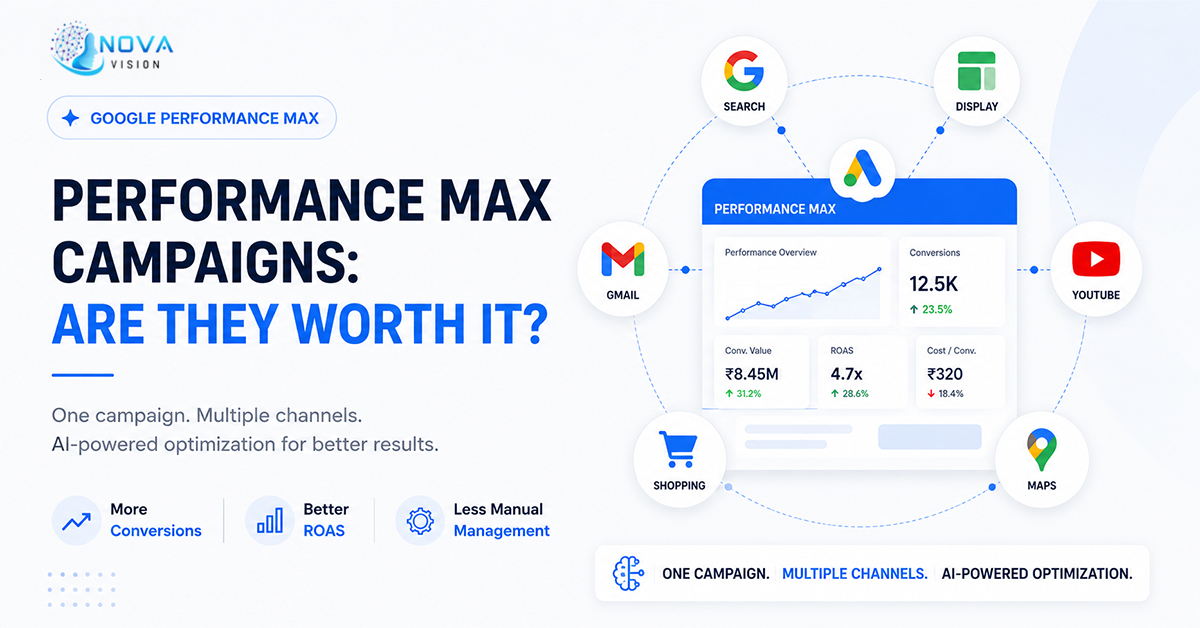
Performance Max Campaigns
-
Call-Only Ads
Google Ads is particularly powerful because it reaches users who are already looking for solutions.
Understanding Facebook Ads
Facebook Ads, now part of the Meta advertising ecosystem, allows businesses to advertise across Facebook, Instagram, Messenger, and the Audience Network. Instead of targeting search intent, Facebook focuses on demographics, interests, behaviors, and online activities.
Facebook advertising is designed to create awareness, build relationships, and generate demand among users who may not yet be actively searching for your products or services.
Common Facebook Ad Formats
-
Image Ads
-
Video Ads
-
Carousel Ads
-
Story Ads
-
Collection Ads
-
Messenger Ads
-
Lead Generation Forms
-
Reels Ads
Facebook's visual-first approach makes it highly effective for storytelling and brand engagement.
The Core Difference: Intent vs Interest
The biggest distinction between Google Ads and Facebook Ads lies in how users interact with each platform.
Google Ads = Intent-Based Marketing
Users actively search for:
-
"Digital marketing agency near me"
-
"SEO services for small business"
-
"Best PPC company"
These users already have a problem and are looking for a solution. Google Ads captures this existing demand.
Facebook Ads = Interest-Based Marketing
Users are browsing social media when ads appear.
They may not be actively searching for:
-
Marketing services
-
Business software
-
Consulting solutions
Instead, Facebook identifies users based on interests, behaviors, and demographics, allowing advertisers to create demand before a search occurs.
Audience Targeting Comparison
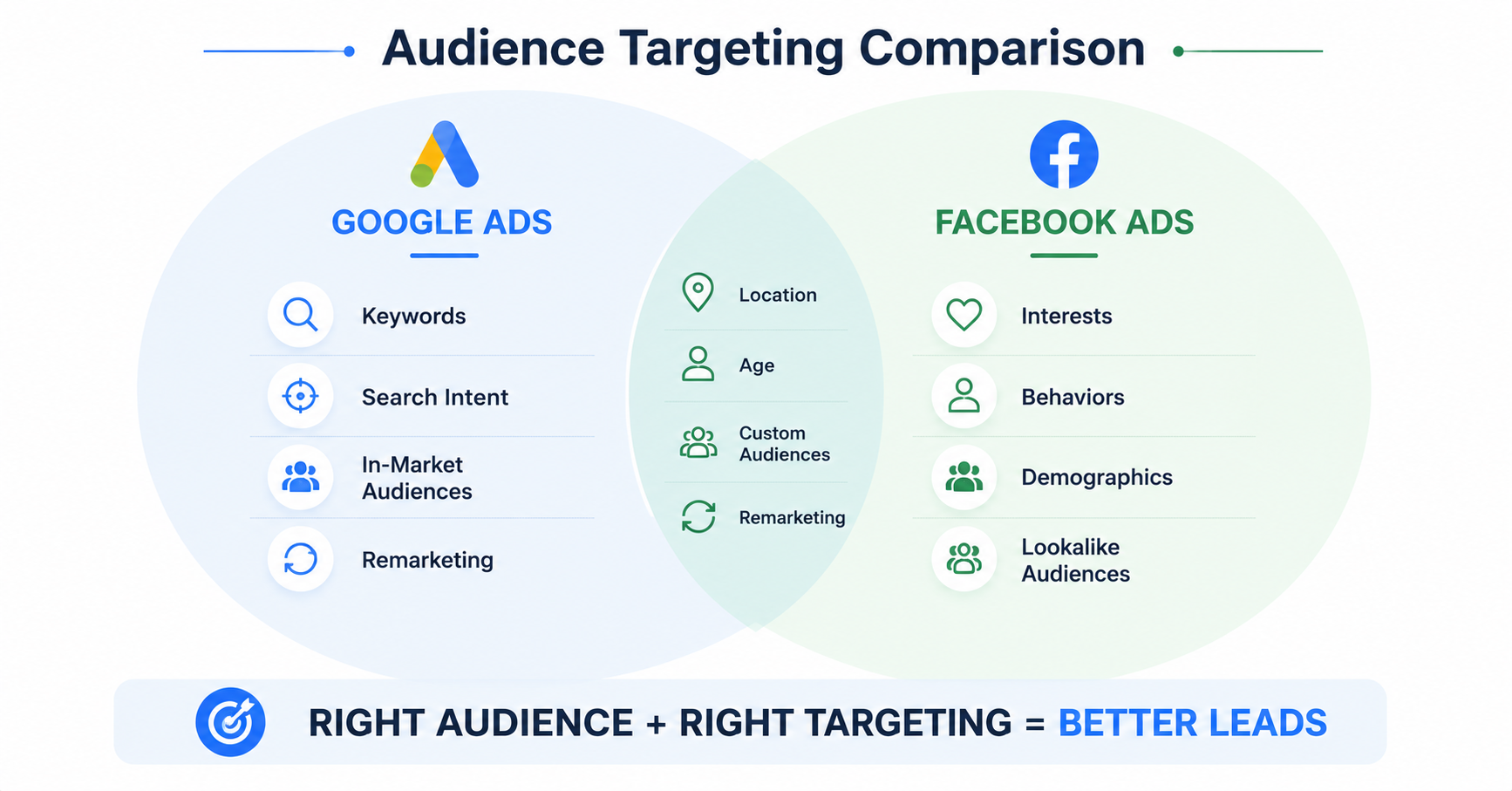
Google Ads Targeting
Google offers targeting through:
-
Keywords
-
Search Intent
-
Demographics
-
Geographic Location
-
Device Type
-
Customer Match
-
Remarketing Lists
-
In-Market Audiences
Google's strength lies in identifying people actively researching products and services.
Example
If someone searches:
"Best SEO company in India"
Your ad can immediately appear.
This makes Google Ads ideal for businesses looking for quick conversions.
Facebook Ads Targeting
Facebook provides incredibly detailed audience targeting options:
-
Age
-
Gender
-
Location
-
Interests
-
Behaviors
-
Job Titles
-
Relationship Status
-
Purchase Activity
-
Custom Audiences
-
Lookalike Audiences
Facebook can target people even before they realize they need your product.
Example
A digital marketing agency can target:
-
Business Owners
-
Startup Founders
-
Marketing Managers
-
E-commerce Entrepreneurs
without requiring them to search for marketing services.
Lead Quality Comparison
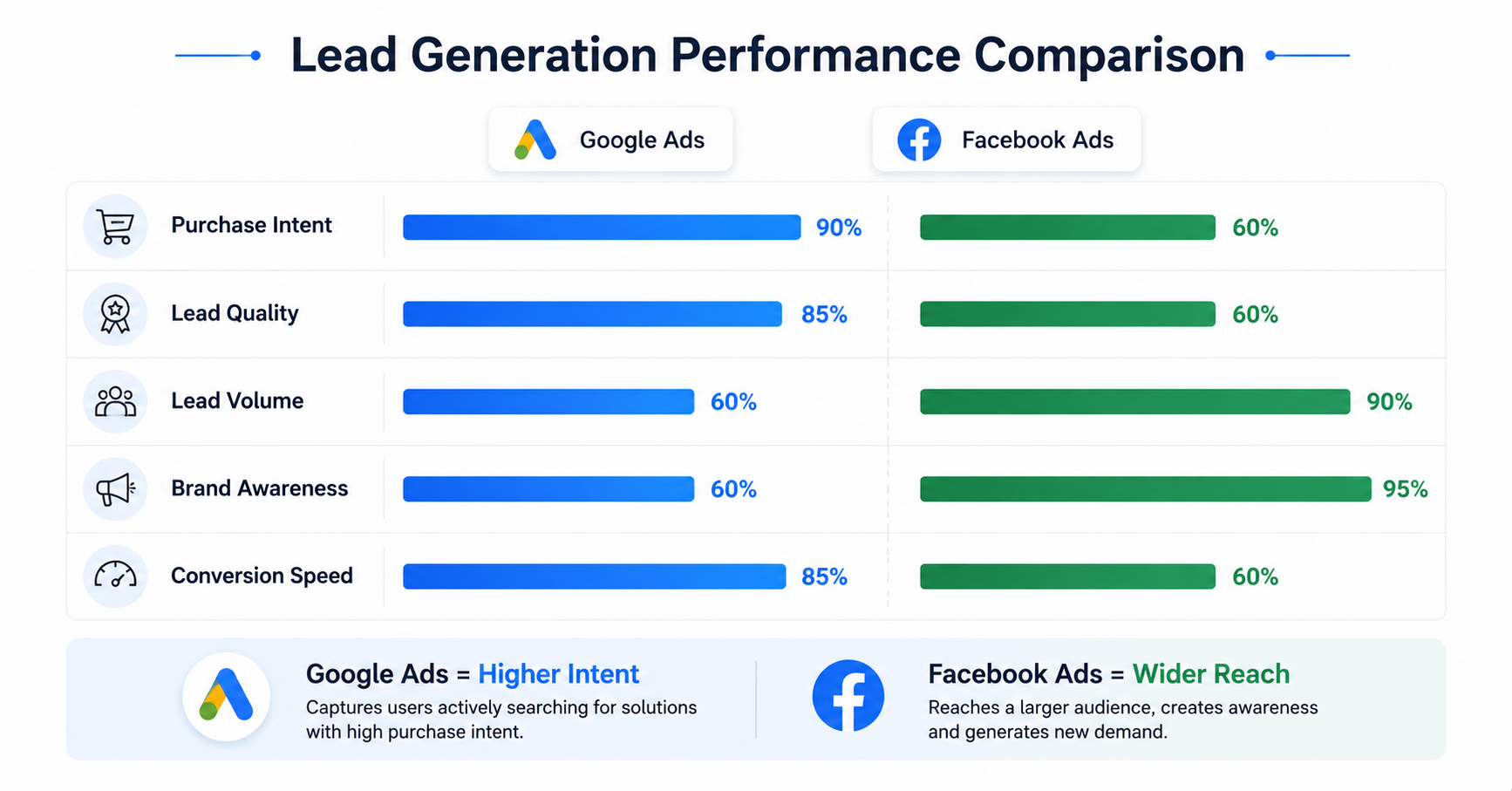
Google Ads Leads
Generally produce:
-
Higher buying intent
-
Faster conversions
-
Better lead quality
-
Shorter sales cycles
Since users actively search for services, they are usually closer to making a purchasing decision. Industry comparisons often note higher intent and stronger close rates from Google traffic.
Ideal Industries
-
Real Estate
-
Healthcare
-
Legal Services
-
Home Services
-
SaaS
-
Education
Facebook Ads Leads
Typically generate:
-
Larger lead volumes
-
Lower cost per lead
-
More nurturing requirements
-
Longer sales cycles
Facebook users often need additional touchpoints before becoming customers.
Ideal Industries
-
E-commerce
-
Fashion
-
Fitness
-
Beauty
-
Lifestyle Brands
-
Coaching Businesses
Cost Comparison
One of the most important factors for advertisers is cost.
Google Ads Costs
Google Ads generally have:
-
Higher CPCs
-
More competition
-
Better conversion rates
Highly competitive industries like finance, law, and insurance often experience expensive clicks due to intense keyword bidding.
Pros
-
Better lead quality
-
Strong ROI potential
-
Faster results
Cons
-
Higher initial investment
-
Competitive keyword auctions
Facebook Ads Costs
Facebook Ads usually offer:
-
Lower CPCs
-
Lower CPMs
-
More affordable testing opportunities
Industry benchmarks frequently show lower lead costs on Facebook for awareness-stage campaigns, though lead quality may vary by industry and offer.
Pros
-
Budget-friendly
-
Wider reach
-
Excellent brand exposure
Cons
-
Lower intent traffic
-
Potential ad fatigue
Ad Creative and Content Requirements
Google Ads
Focuses heavily on:
-
Headlines
-
Descriptions
-
Keywords
-
Landing Page Experience
Success depends on relevance and search intent.
Facebook Ads
Relies heavily on:
-
Images
-
Videos
-
Storytelling
-
Visual Branding
Strong creative assets are essential for success.
Businesses with excellent visual content often perform exceptionally well on Facebook.
Remarketing Capabilities
Both platforms offer advanced remarketing features.
Google Remarketing
Targets:
-
Website visitors
-
Search users
-
YouTube viewers
-
Previous customers
Google can re-engage users across millions of websites in its Display Network.
Facebook Remarketing
Targets:
-
Website visitors
-
Video viewers
-
Instagram users
-
Facebook page engagers
Facebook's Pixel allows businesses to build highly personalized remarketing campaigns.
Which Platform Is Better for B2B Lead Generation?
For B2B businesses:
Google Ads Often Wins
Because decision-makers actively search for:
-
Business solutions
-
Software
-
Professional services
Search intent is typically very high.
Facebook Still Has Value
Facebook excels at:
-
Brand awareness
-
Thought leadership
-
Webinar promotion
-
Lead magnets
Many B2B companies use Facebook to nurture prospects before they convert.
Which Platform Is Better for E-commerce?
For online stores:
Facebook Ads Often Lead
Because:
-
Products can be visually showcased
-
Impulse purchases are common
-
Dynamic product ads work well
Google Shopping Ads Also Perform Exceptionally
Especially when users search for specific products.
The best e-commerce strategy often combines both platforms.
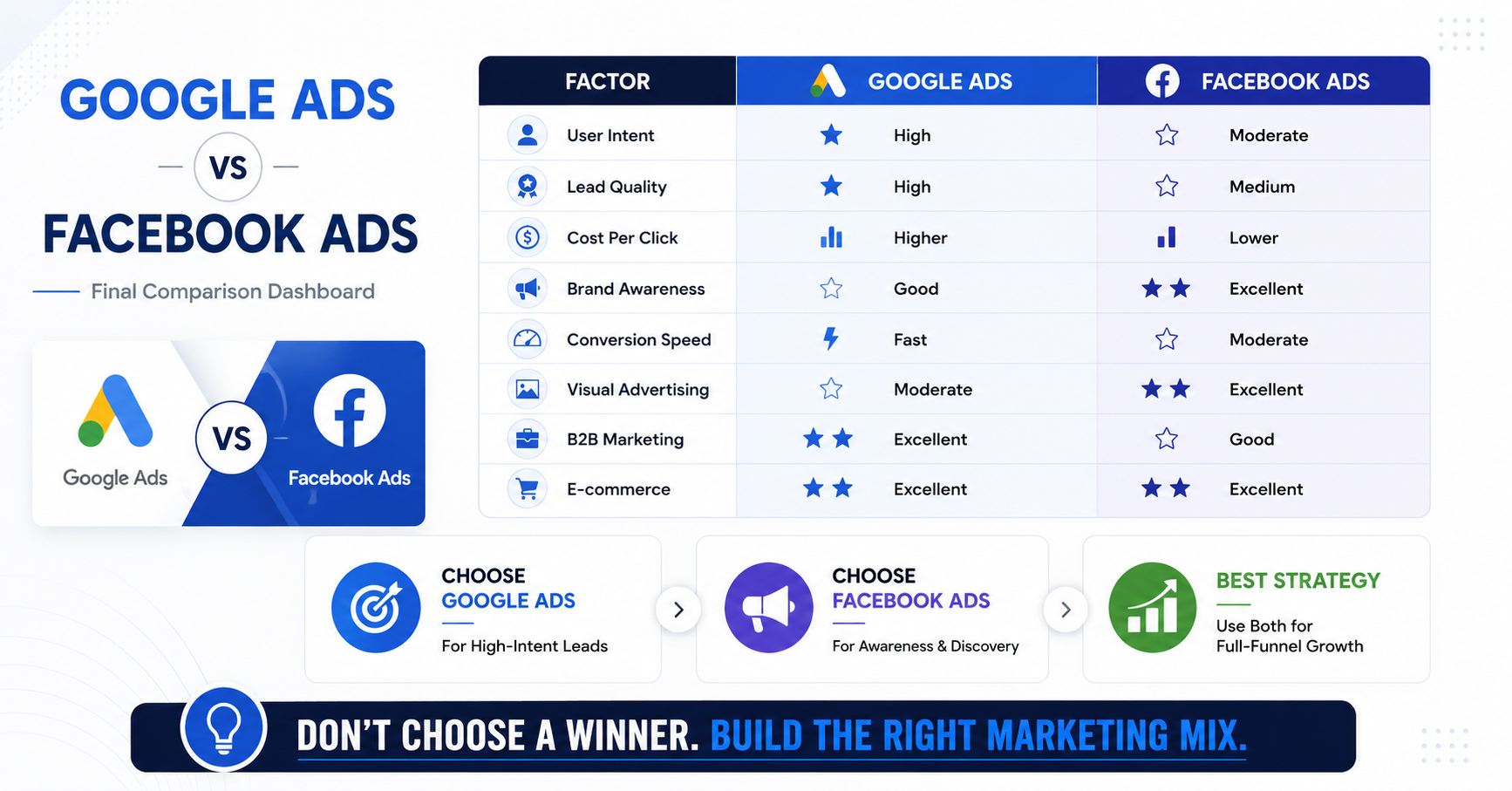
Google Ads vs Facebook Ads: Feature Comparison
|
Feature |
Google Ads |
Facebook Ads |
|---|---|---|
|
User Intent |
High |
Moderate |
|
Lead Quality |
High |
Medium |
|
Cost Per Click |
Higher |
Lower |
|
Brand Awareness |
Good |
Excellent |
|
Conversion Speed |
Fast |
Moderate |
|
Audience Targeting |
Keyword-Based |
Interest-Based |
|
Visual Advertising |
Moderate |
Excellent |
|
Remarketing |
Excellent |
Excellent |
|
B2B Marketing |
Excellent |
Good |
|
E-commerce |
Excellent |
Excellent |
Why Combining Both Platforms Works Best
The most successful businesses don't choose one platform over the other.
Instead, they use both strategically.
Example Funnel
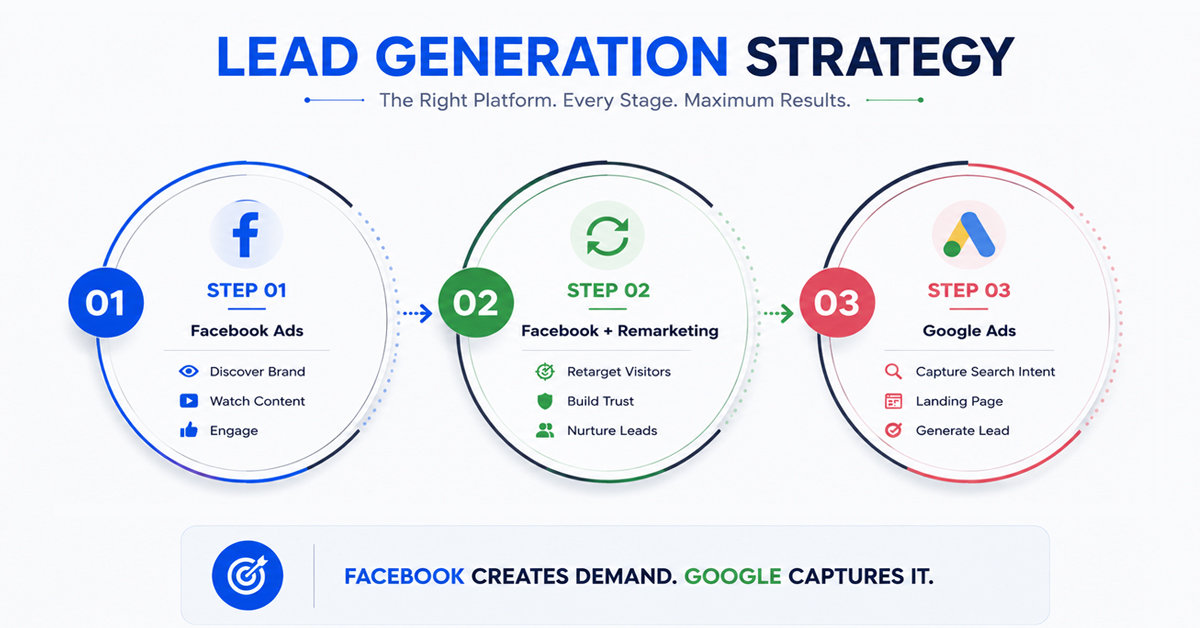
Stage 1: Awareness
Facebook Ads:
-
Introduce your brand
-
Generate engagement
-
Build audiences
Stage 2: Consideration
Retarget users through:
-
Facebook
-
Instagram
-
Display Ads
Stage 3: Conversion
Google Ads capture users when they actively search for solutions.
Marketing experts frequently recommend a full-funnel approach that combines Meta's audience targeting with Google's intent-driven search traffic.
Advanced Strategies to Maximize Lead Generation with Google Ads and Facebook Ads
While understanding the differences between Google Ads and Facebook Ads is important, achieving consistent lead generation success requires more than simply choosing a platform. Businesses that generate the highest return on investment focus on optimization, testing, and audience engagement throughout the customer journey.
The Importance of Landing Pages
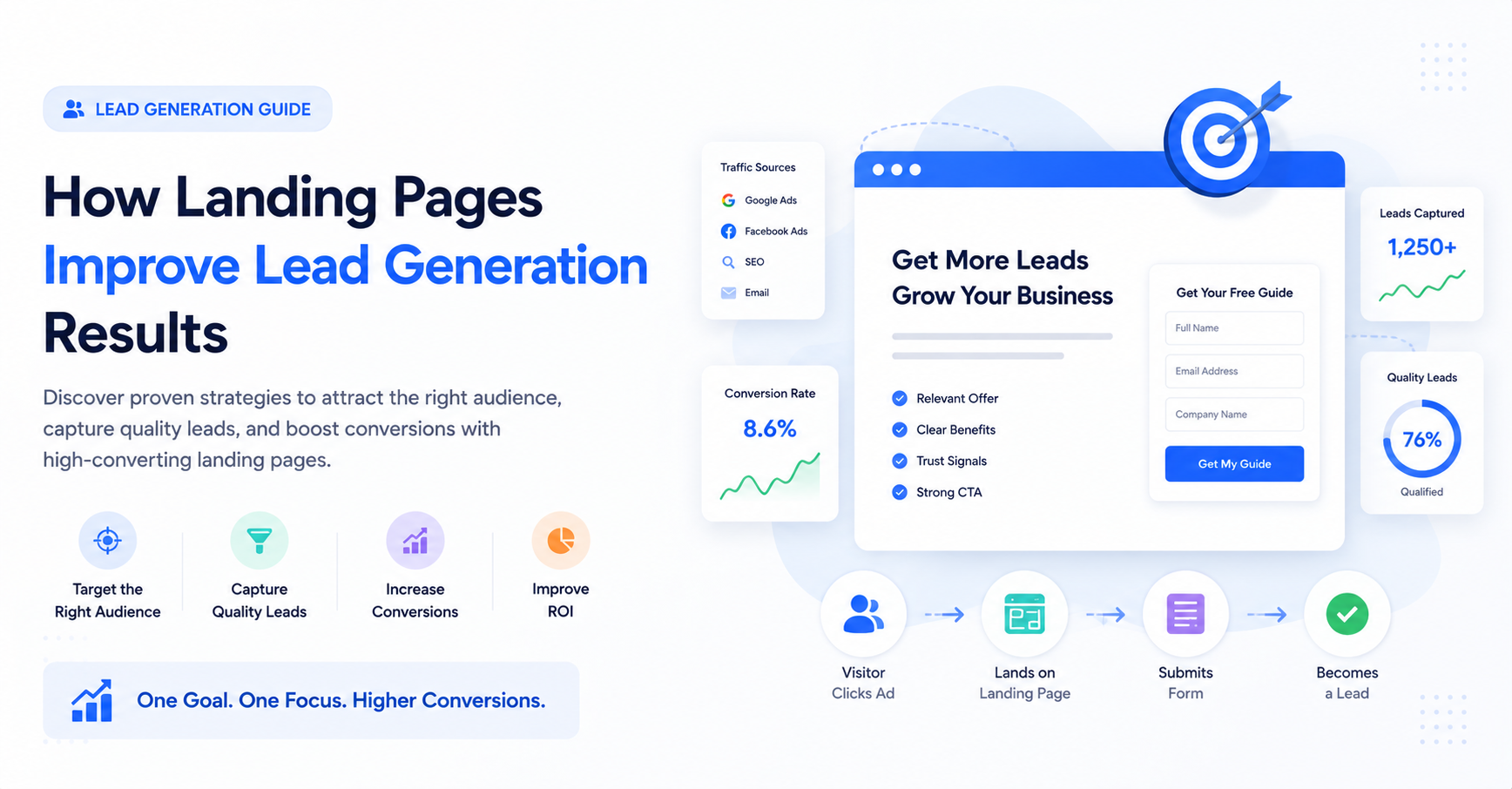
One of the biggest mistakes advertisers make is sending traffic to a generic homepage. Whether users come from Google Ads or Facebook Ads, they should be directed to a dedicated landing page designed specifically for the campaign.
A high-converting landing page should include:
-
A compelling headline
-
Clear value proposition
-
Strong call-to-action (CTA)
-
Customer testimonials
-
Trust badges and certifications
-
Mobile-friendly design
-
Simple lead capture forms
Even the best advertising campaign can fail if the landing page experience is poor. Businesses that optimize their landing pages often see significant improvements in conversion rates and lead quality.
Tracking and Analytics Matter
Successful digital advertising relies heavily on data. Both Google Ads and Facebook Ads provide detailed analytics that help businesses understand campaign performance.
Key metrics to monitor include:
-
Click-Through Rate (CTR)
-
Cost Per Click (CPC)
-
Cost Per Lead (CPL)
-
Conversion Rate
-
Return on Ad Spend (ROAS)
-
Customer Acquisition Cost (CAC)
By regularly reviewing these metrics, businesses can identify what's working and make informed decisions to improve results. Continuous optimization ensures that advertising budgets are spent efficiently.
The Power of A/B Testing
No advertising campaign should remain unchanged for long periods. A/B testing allows marketers to compare different versions of ads and determine which performs best.
Elements to test include:
-
Headlines
-
Ad copy
-
Images
-
Videos
-
Call-to-action buttons
-
Landing page layouts
-
Audience segments
For example, a Facebook campaign may perform better with video content than static images, while a Google Ads campaign may generate more leads with a different headline emphasizing cost savings rather than service quality.
Regular testing helps businesses discover winning combinations that drive higher conversions.
Mobile Advertising Continues to Grow
The majority of internet users now browse, shop, and interact through mobile devices. Both Google Ads and Facebook Ads offer advanced mobile targeting options, making mobile optimization essential.
Businesses should ensure:
-
Fast-loading pages
-
Responsive website design
-
Easy-to-complete forms
-
Click-to-call functionality
-
Mobile-friendly content
A poor mobile experience can lead to higher bounce rates and lost opportunities, regardless of how effective the advertising campaign may be.
Building Long-Term Customer Relationships
Lead generation does not end when a user submits a form. Effective follow-up strategies are critical for turning leads into paying customers.
Businesses can nurture leads through:
-
Email marketing campaigns
-
Retargeting advertisements
-
Educational content
-
Webinars and online events
-
Personalized offers
Facebook Ads are particularly useful for ongoing engagement, while Google Ads can continue capturing users when they are ready to make purchasing decisions.
Future Trends in Digital Advertising
As artificial intelligence and automation continue to evolve, both Google Ads and Facebook Ads are becoming smarter and more efficient. Automated bidding strategies, predictive audience targeting, and AI-driven campaign optimization are helping businesses achieve better results with less manual effort.
Companies that stay updated with these advancements will gain a competitive advantage and improve their lead generation outcomes.
At Nova Vision, we help businesses leverage the latest advertising technologies, optimize campaign performance, and create data-driven marketing strategies that generate sustainable growth. By combining expertise, creativity, and analytics, we ensure that every advertising investment contributes to measurable business success.
How Nova Vision Helps Businesses Succeed
At Nova Vision, we understand that every business has unique goals and customer journeys.
Our digital marketing specialists help businesses:
-
Build profitable Google Ads campaigns
-
Create high-converting Facebook Ads
-
Optimize landing pages
-
Improve conversion rates
-
Reduce acquisition costs
-
Generate qualified leads
-
Increase ROI
We develop customized advertising strategies based on your industry, audience behavior, and business objectives.
Conclusion
The debate between Google Ads and Facebook Ads isn't about determining a universal winner. Instead, it's about understanding which platform aligns with your goals.
Choose Google Ads when:
-
You want high-intent leads.
-
Customers actively search for your services.
-
You need quick conversions.
Choose Facebook Ads when:
-
You want brand awareness.
-
You need audience discovery.
-
Visual storytelling is important.
For most businesses, the strongest results come from combining both platforms into a unified lead generation strategy. Google captures existing demand, while Facebook creates new demand and nurtures future customers.
By leveraging the strengths of both platforms, businesses can build a complete marketing funnel that consistently generates leads, increases sales, and drives long-term growth.